Showing posts with label Bible. Show all posts

March 20, 2013

Richard Schultz, Out of Context

Richard Schultz, a professor of OT at Wheaton College, takes readers on a journey of learning. The terrain is biblical interpretation. This book, intended for the general reader, is full of very sound advice in how to approach the biblical text. Key to his argument is that misinterpretation is all to common in the church today. After a brief by entertaining introduction based on the Jabez prayer phenomenon, he helps readers appreciate why misinterpretation is dangerous. He then gives a very well-rounded set of instructions for how to pursue a sound interpretation of the text that appreciates its cultural and biblical context, harnessing a broad array of hermeneutical tools in a helpful and friendly way. I think this book does a great service in both laying bare the misuse of Scripture that is too often let pass in the church and in popular Christian literature and at the same time making a case that anyone can handle the Bible in a responsible manner. Schultz's work can help give confidence (and also some important caution) to anyone who desires to treat the Bible with the respect it deserves. This is an important way we can all show the true value of God's Word.

In the interest of full disclosure, I work for the publisher of this book, though this was not one of my projects (though I do look forward to working with Dr. Schultz on a Proverbs commentary in the future). All opinions are expressly my own.

Timothy Keller, Galatians for You


In this mini-commentary, well-known pastor Timothy Keller seeks to illuminate the text of Galatians in a way that any Christian can better understand the message in the text and be challenged to know God more deeply. Galatians is divided into thirteen units, and each unit is then subdivided into two parts. For each part, Keller discusses the major themes in the text, always paying quite close attention to what the text actually says without necessarily commenting on every phrase or verse. Each section concludes with a few questions for reflection. Keller is a clear writer, and this book showcases that well. He is also a perceptive reader of Scripture, and it is here that this book shines. It is not a commentary, and certainly doesn't engage every important academic debate, but at the same time Keller is able to bring to bear a lot of learning about the text in an unassuming way.

The book is meant for three different purposes. First, it is meant for reading, and for that purpose, it is quite adequate as a guide to understanding Galatians better. Second, it is meant for study and devotions, and the division into similarly sized units and questions for reflection can help take learning deeper. Third, it is meant as a leadership resource, to help group leaders prepare studies or pastors prepare sermons. I think it will work fine in all three contexts. Because there are only three reflection questions at the end of each unit, study leaders will have to plan on either using it alongside another study guide or writing a number of their own questions to supplement and help group members get into the text and cover some of the themes, tough the questions he does have are often useful for digesting the message and importance of Galatians and how it can be applied. Keller deftly balances commentary with perceptive interpretation and application in a way that makes this a useful guide for people at all levels of familiarity with Scripture. I will certainly draw on it when I prepare lessons on Galatians.

Thanks to the publisher and Cross-Focused Reviews for the review copy.

June 22, 2012

On believing and being a Christian, or reflecting on one of the "hard" parts of the creed

I love to read blogs, at least most of the time, and I enjoy the academic aspects of the Christian faith: the questions of authorship of the various documents of the Bible, the theology the various authors exhibit, the scope and content of the gospel message first preached and passed down by the apostles, and it goes on and on. But every once in a while, I'm jarred by a post, jarred back to what it is all about. And a beautiful post by theologian Ben Myers over at Faith and Theology did that for me today. I'll get out of the way now and just say simply, "read it."

Striving to become young, and grateful to be found in Christ,
James

April 30, 2012

Discussion of Peter Enns, The Evolution of Adam

I read Peter Enns' interesting and provocative The Evolution of Adam a couple months ago. It has a lot of interesting things to say about the important issue of how the science-and-religion dialogues (and the related issue of the rise of critical biblical scholarship) of the past century and a half (and beyond) come to an interesting head in the discussion of the historicity of Adam and Eve. Really, in my opinion, this is one of the key points at which, with regard to the larger science-and-theology dialogue, the rubber meets the road, so to speak. I found his book interesting, though not all-together satisfying. But others are engaging Enns as well.

Jamie K. A. Smith has recently published a review of Enns focused largely on methodology, specifically pressing him on what he sees as a "flattening" of Scripture by functionally excluding divine authorship. J. R. Daniel Kirk responds to Smith's review, and in the comments of his critique, Jamie Smith and also Alan Jacobs enter with some push-back. It makes for an informative conversation about the role divine authorship plays as we look at difficult interpretive issues in Scripture. Do read, and do read Enns's book, critically.

February 14, 2012

Review of NIV Life Application Bible

With the release this year of the updated translation of the NIV, Zondervan has released an updated version of their well-known Life Application Bible. I would like to review it briefly, with a review in three parts. First, some brief thoughts on the updated NIV text itself, on which the Bible is based; second, a note about the application and study features; and third, look at the aesthetics of the Bible and its production.

First, the translation. There has been much controversy surrounding the release of this latest revision of the much loved NIV text, much like the controversy surrounding the release of what became the TNIV in 2005. This most recent NIV does preserve many of the changes that were made in the TNIV, though there are a small percentage of changes where the language has reverted back to the familiar text, along with some places where further revisions were made. I don't want to go into all of the details here. But in short, this latest NIV preserves the tradition of an outstanding translation that is readable and comprehensible. The translation committee is top notch, and contrary to much press to the contrary, not out to foist an egalitarian position on the Biblical text (most of the committee members are of the complementarian position, including the chair, Doug Moo). From what I have seen of the translation, it will be an outstanding text for reading and for study, and I am happy to have this latest version in my hands. 

Second, the application features. The Life-Application Bible has a nice mix of study and application features to aid in Bible reading. Each book is introduced with a two-page overview that helpfully positions the book in its historical context, looks at its main messages (referred to as "megathemes"), gives an outline of the text, and, not surprisingly, focuses throughout on the importance of these things for application, while also including the important components like author, date, and setting that prove helpful in reading. Throughout the text of the Bible itself, there are explanatory and application notes at the bottom of the pages, giving useful background or explanation where necessary, but focusing on how different events, exhortations, or teachings can be applied (for example, in Joshua 9, dealing with the opposition Israel experienced, the notes on 9:1-6 say, "We can expect similar opposition as we obey God's commands. . . . We must rely on God and communicate daily with him." These notes show a deep and sustained reflection on the relevance of the text for the lives of Christians today, and are an exercise in reading the Bible as Christian scripture, having relevance for life today. There are also brief outline markers and short descriptions interspersed within the text to mark major divisions in the various books to show the proposed outline structure as you are reading (usually not more than a head or short descriptor every few chapters). There are also other helpful study and application features, such as character studies, maps, and helpful discussions of major themes that pull in details from various passages throughout scripture.

Last, the aesthetics and layout. The Bible is nicely laid out in a one-column format which makes for easy reading. The study and application notes run across the bottom of the page in an easy-to-read sans-serif font, and there are cross-references at the center (gutter) of each page, pointing to other texts that would prove helpful in study. I am reviewing the full-size bonded-leather version, which borders on being too large to carry, but is still manageable; the cover seems relatively durable, though I know from past Bibles that bonded leather does wear out and can begin to flake after years of wear, but how this Bible will fare won't be know for a few years.

In all, I am quite impressed with the quality and usefulness of this Bible. It has lots of helpful study features to help orient the reader to the original meaning and context of the Bible, but it also has abundant resources for thinking through not only what a text means but how the reader can apply it and be challenged and changed by it. I expect to get much good use of of this Bible both in my own personal reading and also as a resource to prepare for teaching the meaning and application of the text. I can see it being of great use to a broad spectrum of Christians for both study and devotional use.

Thanks to the Amazon Vine Program and the publisher, Zondervan, for the review copy. Also in the interest of full disclosure, I am an employee of a competitor of Zondervan.

November 30, 2011

NIV (2011) Study Bible review

With the release this year of the updated translation of the NIV, Zondervan has released an updated version of their well-known study Bible. I would like to review it briefly, with a review in three parts. First, some brief thoughts on the updated NIV text itself, on which the Bible is based; second, a note about the study features; and third, look at the aesthetics of the Bible and its production.

First, the translation. There has been much controversy surrounding the release of this latest revision of the much loved NIV text, much like the controversy surrounding the release of what became the TNIV in 2005. This most recent NIV does preserve many of the changes that were made in the TNIV, though there are a small percentage of changes where the language has reverted back to the familiar text, along with some places where further revisions were made. I don't want to go into all of the details here. But in short, this latest NIV preserves the tradition of an outstanding translation that is readable and comprehensible. The translation committee is top notch, and contrary to much press to the contrary, not out to foist an egalitarian position on the Biblical text (most of the committee members are of the complementarian position, including the chair, Doug Moo). From what I have seen of the translation, it will be an outstanding text for reading and for study, and I am happy to have this latest version in my hands.

Second, the study notes and features. I have owned three previous editions of this study Bible, and from what I can see, the notes are largely unchanged. Each book of the Bible has a general introduction, that covers issues of authorship, audience, context, major themes, and an outline. These provide helpful information for getting a handle on what is going on for each book of the Bible. The second major "study" feature is study notes that run along the bottom half of each page, helping to explain or give additional background on key words or phrases, people, or themes from the text. They don't cover every verse, though more verses than not probably have some type of note. The third major study feature is the cross-reference system that helps point to other passages in the same book, in the same testament, and across both testaments that use a word or phrase. These are helpful basic resources (of these features, I find I use the cross-references the most). The endmatter includes a truncated but still useful concordance (I love having this right in my hands, even though it's getting easy to just look up passages and word-references on the internet), an index of subjects (that is, a topical index of what biblical passages cover various themes), an index of the notes, pointing the reader to various notes that cover a person or topic, and some helpful study maps.

The third aspect of this Bible upon which I want to comment is the aesthetics. The major change, besides the updated NIV text, from previous editions, is that the Study Bible is now set in four colors throughout. Select color images have been added throughout the text, both in the book introductions and in the text itself, and these add some visual interest and also illustrate the text with archaeological images from relevant contexts. The four-color interior does add a little bit to the overall feel, but the main improvement is in the charts and the already-mentioned images. But it's not an overly exciting interior; the layout is quite functional, with all of the elements working together on the page, just like in most previous editions of this Study Bible.

Overall, I give this Bible four stars. It's a nice, functional Study Bible. It is relatively conservative in its overall approach, but it isn't slanted to a particular tradition, and its notes are dependable, and provide a solid resource to draw on. I love the TNIV Study Bible that I have used over the last few years, with its one column layout, and hope they will soon bring out this new NIV Study Bible with that same format, which makes for easier reading and leaves nice room for notes. The color, images, and revamped charts and maps make this a nice Study Bible, and certainly a strong option.

Thanks to Zondervan and the Amazon Vine program for the review copy.

September 23, 2011

Scot McKnight, The King Jesus Gospel

Thanks to Zondervan for the review copy of The King Jesus Gospel: The Original Good News Revisitedand the spot on their blog tour for this great book.

Scot McKnight, professor of religious studies at North Park University, is a widely respected academic, with important books in a number of topics in New Testament studies, and he is also widely known as a popular speaker, author, and blogger. This means he is uniquely positioned to bring academic learning to bear on a wider audience, and this is exactly what he does in The King Jesus Gospel.

There are so many ways one could approach the review of a book like this, with historical arguments, exegesis, theological synthesis, and practical and contemporary application. I have chosen to make this review a summary of the key points, touch on why it resonated so much with me, and conclude with a sustained note of hope for how this book might point in a refreshing direction for gospel thinking and for evangelicalism, and of hope that evangelicalism is poised to heed his call.

McKnight's book is subtitled The Good News Revisited, and that sums up well its topic: it's all about the gospel. And his big contention is that many evangelicals today (and he particularly speaks to evangelicals, though his topic certainly has much wider relevance) focus on and proclaim the plan of salvation without realizing that the gospel is so much more. He asserts very simply (and this is sure to step on some toes) that evangelicals should really be called "soterians" because of the focus on "salvation," often thought of as making a "decision" for Christ, which is the key point of a gospel presentation. Instead, McKnight asserts that the gospel is the good news of God's faithful working in the world by sending his son Jesus to fulfill his promises, redeem his people, and defeat the powers of sin and death. This doesn't entail negating the soterian gospel, but instead affirms its core while recontextualizing it especially around the story of Jesus as King and Messiah. This is still a gospel that is radically "for us" and still deals with sin and calls for response (the need for response is one of the key elements McKnight highlights in the apostolic gospel), but it sets this in the framework of what Jesus accomplishes on the stage of history and in the plan of God. In short, the gospel is the story of Jesus as it completes the story of Israel.

Part of McKnight's expansive argument is a historical one: The Jesus story becomes abstracted into a generic story of God's love, wrath, and grace focused on Jesus' salvific effects. He highlights (without villainizing) the Reformers, both Lutheran and Reformed, showing how their creeds changed from a "gospel" focus that centers around a narration of Jesus' life and significance to a salvation focus that reorders and refocuses Christian faith around issues of personal response and human responsibility. These seeds were cultivated through the revivals and evangelists of the nineteenth and twentieth centuries and also by a focus on experience as a key to the Christian life.

Another key theme in McKnight's book is that the Gospels preach the gospel. It isn't uncommon today for people to wonder if the Gospels, or if Jesus himself, preached the gospel. McKnight asserts, rightly I think, that people are really asking if Jesus or the Gospels teach the "plan of salvation," and that answer isn't always so clear. But, he asserts, the Gospels are the preeminent examples of gospeling, of declaring that the story of Jesus is the culmination of the story of Israel and is good news for its hearers. This reappraisal of the Gospels and their relation to the gospel is, I think, one of the key points of the book, and one of its strongest arguments, especially as it is coupled with his reading of 1 Cor 15 as a key gospel text for Paul and with his investigation of the gospelingsermons in Acts.

Throughout the book, McKnight exhibits a loving and irenic, though earnest tone. He brings in John Piper and Jonathan Edwards for appreciative comment, just as he does N. T. Wright and Dallas Willard. Though this book may in some ways constitute a major challenge to evangelicalism and its understanding of the gospel, it is written as a hopeful critique from the inside, as opposed to an attack from without. And hand in hand with this tone goes the fact that McKnight is quick to appreciate the positive and enduring aspects of evangelical life and faith, even as he seeks to augment and complete them with greater understanding and a larger story-frame. He may make some important and even controversial assertions, but he is very careful with his denials (that is, he repeatedly reaffirms that Christ's death is for us, and that it is all about salvation; we do need to respond in faith; the gospel leads to a transformed life). At its core, the theme of salvation isn't lost at all, it is simply recontextualized within Jesus story as it completes Israel's story.

I loved McKnight's book! It answered the questions that were only partially formed in my mind. It was a book I didn't know I needed, but it put into words various themes and streams of thought that have been swirling around in my mind: everything from how Jesus' life and teaching fit into the gospel to how the Old Testament relates to the new to how discipleship relates to salvation (and how we present that). Jesus is Messiah and King, and that has profound implications for the whole world. We are called to proclaim that good news far and wide. And it is good news for salvation. 

I conclude this review with a note of hope. I have profound hope that evangelicalism is ready for this reawakening to a fuller understanding of the gospel of King Jesus. Anyone who reads in academic biblical studies knows that evangelicals have been in the forefront in investigating the relation between the two testaments, and how a full and careful understanding of the larger story of Israel is essential to reading the New Testament. Though I could name many, a few key books I might highlight are Richard Hays' work Echoes of Scripture in the Letters of Paul is a ground-breaking study of OT echoes and allusions in Paul; Beale and Carson, eds., Commentary on the New Testament Use of the Old, systematically undertakes a study of how the OT figures in the NT book by book; N. T. Wright, in many books, has looked at how Israel's story creates a key component of the NT worldview and is essential to understanding Jesus; and last, though certainly not least, Christopher Wright's magisterial The Mission of God outlines the Bible's grand story of God's mission in his world and our part in it. So many more could be named, but these few illustrate how we are coming to grips in new and fresh ways how the story of the Bible is the gospel. I also thing that evangelical culture itself is shaped in such a way that the broader apostolic gospel that McKnight outlines will fit its major contours even better than the more narrowly soterian version, even if it is a bit uncomfortable in places and feels a bit different. Evangelicalism is by nature full of Jesus-devotion, and a renewed focus on his life, death, and resurrection will be a natural fit. Evangelicalism is very intentionally a movement that highly values Scripture, and the apostolic gospel makes the whole Bible, from Gen 1 to Rev 22, come alive as a gospel story, and that is sure to reinvigorate a people who already love God's Word. And evangelicalism loves to share God's love by telling stories. I think of the great hymn, "I Love to Tell the Story," which both demonstrates that the broader story-shaped apostolic gospel has been a formative part of evangelical culture and that this same evangelical culture has many resources already at its disposal to energetically embrace the apostolic gospel that McKnight describes.

In sum, I enthusiastically commend this great little book. There is no doubt, as with any major and sweeping thesis like this one, that details will need fleshing out a bit, and various formulations and points may need honing. But I think his core argument is a very persuasive one, and I look forward to digesting it with others over the coming months in hopes that it will be instrumental in transforming my life, our churches, and our evangelical culture to be truly gospel-centered.

August 19, 2011

The IVP Dictionary of the New Testament

IVP's "black dictionary" set has rightfully met with wide acclaim. The New Testament set, which is already complete, consists of four substantial volumes, The Dictionary of Jesus and the Gospels, The Dictionary of Paul and His Letters, The Dictionary of the Latter New Testament and Its Developments, and The Dictionary of New Testament Background. Each one of these volumes is filled with outstanding contributions by leaders in their field. Authors include the likes of Larry Hurtado, Ben Witherington, Scot McKnight, F. F. Bruce, I. Howard Marshall, Craig Evans, and Craig Keener. And the articles are substantial, usually filling numerous dictionary pages. This one-volume compend is a distillation of the four New Testament volumes into one large volume. They did this by selecting various articles from each of the four individual volumes that would best serve for a more introductory volume. This means they have included an article on each book of the New Testament, as well as what the editors determined to be the most helpful of the other articles. I have no doubt that a careful review of what was included and what was omitted would result in various quibbles about what should have been deemed essential, but I can easily say that they have created a spectacular and affordable resource. And, to my mind, one of the best features is that they have essentially left the articles in their original form. That is, they haven't created summaries or abbreviations of the individual entries, but left them as they were originally written, so the level of scholarship is still high, and only the article selection is curtailed. In all, I'm happy to enthusiastically recommend this resource. It is an outstanding place to start and at the same time a thorough and updated resource on many important topics.

May 28, 2011

Kenneth Kitchen, On the Reliability of the Old Testament

If you have watched any Nova or National Geographic specials on pretty much any facet of the Old Testament over the past few years, it very quickly becomes obvious that a rather stark historical minimalism is dominant in the scholarly world, or at least the scholarly world they feature. And this could be dismissed as just media bias, but a similar minimalism is also quite prominent in the OT academic circles and is evidenced in many introductory OT textbook. So what in the OT is historical? The Bible certainly treats the major characters and events in the OT as historical, and it builds its understanding of God and his character from God's acts in history (God is the God of Abraham, Isaac, and Jacob, the God of the exodus). So if the OT was entirely made-up history, a fictional construct from after the exile to give a rag-tag band of people an identity, that would have pretty profound implications for how we understand God and how we understand the Bible.

K. A. Kitchen, an emeritus professor of Egyptology at Liverpool University, takes these questions head on, as he systematically looks at the historicity and plausibility of the OT writings in their historical contexts. The book is a detailed era-by-era investigation into the Biblical text (sometimes point out that what we assume the Bible says isn't actually what it reports), cultural settings, archaeological discoveries, and documentary and inscriptional evidence from the Levant and the surrounding world, in order to see whether the Bible's historical record fits with, and often intersects with, the history as it can be understood from outside the Bible.

The book is filled with detail. It is 500 pages of discussion of the evidence and the various approaches to its reconstruction along with careful evaluation of how the historical and archaeological data coheres with the Bible, along with another 150 pages of notes, diagrams, and indices. That's all to say, he deals with all of the major issues that arise out of this wide-ranging subject matter. This mountain of detail and discussion is made easily navigable by its good organization, helpful use of charts, and its concise summaries at the end of each chapter.

Kitchen's careful conclusion is that the minimalism so prevalent in the academy and in popular scholarship today is merely a relic of past assumptions now eclipsed by the evidence. He concludes his investigation of whether the Biblical writings were composed entirely within the postexilic period (400–200 B.C.) or whether they reflect their purported historical settings by asserting, with regard to the divided monarchy, exile, and return, that the Bible's accounts of these periods "show a very high level of direct correlation (where adequate data exists) and of reliability." And, concluding on what can be said of the historicity of the accounts before the united monarchy, when direct evidence is more difficult to find, that "the Hebrew founders bear the marks of reality and of a definite period." Thus, he concludes that the Bible's historical accounts make sense in the times that they purport to represent, and don't give evidence of a postexilic invention so popular in academic circles. I must also say that while Kitchen's study is indeed detailed, it is also entertaining, as he shows a warm and sometimes scathing humor as he looks at historical evidence or at rival historical reconstructions. The book was enjoyable to read, and is a very helpful push back against the minimalism that can begin to erode Biblical faith. It certainly isn't the last word on any of these matters, but it is an important and substantial tome that will need to be reckoned with. And if you're not ambitious enough to dig in to all of the data, selective reading of especially important topics and careful reading of all of the introductory and summary materials makes for a good overview of the relevant materials.

April 16, 2011

Carlson and Longman, Science, Creation and the Bible

In this brief and general-reader-friendly book, physicist Richard Carlson and Biblical Studies professor Tremper Longman III undertake an attempt at a solution to the perceived conflict between the Genesis creation accounts and modern science. They advocate a reconciliation between the two disciplines, and they do this by making the following argument (their thesis statement, which appears on page 14):

The first two chapters of Genesis, which accurately present two accounts of creation in terms of ancient Hebrew scientific observations and heir historical understanding, are neither historical nor literal in the twenty-first-century literal sense. Instead, the underlying message of these chapters applies for all time and constitutes a complete statement of the worldview of the Hebrew people in the ancient Near East. They accurately understood the universe in terms of why God created it but not how in the modern scientific and historical sense. This worldview, markedly different from those of their pagan neighbors articulates the principles underlying their understanding of the relation of God to the universe, their relation to the true God, and their relation to each other and to the created order.

This book has a number of strengths, as the authors seek to make their case for this thesis. The principle strength is that it distills a lot of technical and academic thinking and writing into a very readable presentation that introduces some of these concepts and arguments to people who aren't otherwise familiar with them. For instance, the writers use some of John Polkinghorne's work to present a vision of the relationship between science and theology that goes beyond the popular conflict motif to a much more nuanced understanding of two disciplines with different spheres of study and different aims. The second major discussion that lays the groundwork for their thesis surrounds biblical hermeneutics, that is, how we read the Bible. Here again the authors present in simple terms an approach to reading the Bible that pushes people to be self-conscious in how they are interpreting the Bible and opens up the question of genre, the more of less formal conventions that guided both author and audience in understanding the type of text being presented. They discuss at length an incarnational model for understanding the Bible as both a divine and a human book. They also push for the category of myth as being helpful when looking to Genesis 1 and 2 and make a case from some contemporary authors such as C. S. Lewis for the usefulness and legitimacy of Christian myth.

The authors then move on to a reading of the major creation texts in the Old and New Testaments, preparing the way for a careful reading of Genesis 1 and 2 to investigate its place in the canon, its teaching, and its context in the ancient Near East. They assert that Genesis 1 and 2 should be read as a worldview statement for the ancient Hebrews, a statement that is made in a two-layered story, one layer being that of a story of the experiences and understandings of the ancient Hebrews, and a second layer consisting of the theological story they wanted to convey. It is the second, theological layer that is important for us today. They also point out both the similarities and the difference between the two Genesis accounts, concluding that the differences cue us in that these stories aren't meant to be read literally, since the author left in what would otherwise be viewed as conflicting details.

I have many reasons to commend this book. It is readable, and it helps to get people thinking in a critical way about what is perceived as a major conflict for Christians today between science and the Bible. I think many of their ideas are very helpful, and I do think that reading Genesis 1 and 2 against the back drop of the ancient Near East gives much greater understanding of these passages than a surface reading by someone in the twenty-first century alone could. I am also in agreement with the basic outline of the relationship they sketch between science and theology and hope this popular-level treatment brings that understanding to a wider audience. There were, I thought, a few weaknesses in the book. For me the largest one was the lack of useful summaries at the end of the two chapters investigating the creation texts in the NT and OT outside of Genesis 1 and 2. I thought these were interesting chapters, but they didn't seem to add much to the argument. Or, at least, their place went largely unstated beyond a few allusions. I also thought they ignored one of the most important "losses" as they term it, if their non-literal approach to Genesis 1 and 2 is adopted, namely the question of the historicity of Adam and Eve and the implications of that discussion for our understanding of humanity, the image of God, and the origin and character of sin. Although it is a complicated question, its exclusion seems a glaring omission (though it could be argued that it is technically outside their scope in focusing on Genesis 1 and 2, but Genesis 2 and 3 clearly for a unit of story, so decisions about one would likely have implications for understanding the other).

In conclusion, I hope many people read this book, and I do happily recommend it. There are pieces that could have been stronger, but it is overall a very clear statement of a better way of thinking about science and the Bible than the conflict model, and it helpful points Christians in a better direction.

September 18, 2009

Three by Gordon Fee

Three items related to Gordon Fee for today. First, I'm working my way through God's Empowering Presence and have, as I expected, been awed by his scholarship and exegesis, but even more, have been entranced by Paul as he comes through in Fee's writing. This book has received wide praise, and it was about time I finally got to it. I haven't got to the synthesis chapters yet at the end, but the exegesis is well done, especially his overviews of the books and their arguments.

Item two is that Fee has a new commentary out in the NICNT series which he edits for Eerdmans on 1 and 2 Thessalonians, which I hope to pick up soon. His Philippians volume in that series is a volume I deeply appreciated, both for it's learning but even more for its pastoral sensativity and it's helpful words of application.

Third, I just picked up, again long overdue, Fee's Listening to the Spirit in the Text. Reading Fee always makes me want to read more of him, and this collection of essays has some great stuff on Paul, so it fits right in with my current Pauline emphasis.

July 15, 2009

N. T. Wright, Justification

Justification is one of the core doctrines of the Christian faith, and in both evangelical and more mainline circles, it has been contested territory for a generation or more. N. T. Wright is one of the giants of biblical studies today, with broad recognition in both academic and in more popular circles, with an important multi-volume series from Fortress Press, Christian Origins and the Question of God, and with a string of popular presentations of important facets of the Christian faith, Simply Christian, Suprised by Hope, and After You Believe, all from HarperOne. He is also important because of his rather unique ability to attract admirers and detractors from across the theological spectrum. With his keen insight into Paul, both building on his past work and in anticipation of his forthcoming academic work on the Apostle, this important work zeroing in on the doctrine of justification is one for which I eagerly awaited. And Justification is truly a book to be reckoned with. It is a comprehensive (though, as the author admits, not exhaustive) statement of the place of justification in Paul's thought, and I find myself far more appreciative than anything for this carefully reasoned book.

Wright begins by laying out some important groundwork for the present book by locating it especially within the evangelical conversation concerning the classical "Reformed" view of justification, especially as espoused by John Piper (whose recent book, The Future of Justification, was a sustained critique of Wright's perspective particularly on this issue), and locating his views with reference to the new perspective on Paul, of which Wright could be considered one of the primary contemporary proponents, though he seeks to provide "fresh" perspectives that move beyond what is often termed the "new" perspective. I'd like to proceed in a thematic way by extending some words of appreciation and interest toward a couple of Wright's major themes.

Clearly, the largest idea that Wright advocates is locating of the doctrine of justification, and the understanding of the "righteousness of God," firmly within the context of covenant. He describes God's righteousness as God's covenant faithfulness, and, more specifically, God's faithfulness to the one-plan-through-Israel-to-the-world. The problem that God addresses in the Messiah is that Israel has failed in its part of the plan, to be God's instrument in and to the world, so the plan becomes one-plan-through-the-faithful-Israelite-to-the-world, as Jesus the Messiah becomes the instrument of God's work in and to the world, fulfilling God's covenant plans, demonstrating God's faithfulness to the covenant with Abraham even though it seemed to be foiled by sin.

Wright seeks not to upend the traditional Reformation emphases of justification by faith, God's grace, forgiveness of sins, but instead to locate them in the broader, deeper, and what he asserts to be more truly Pauline story of God's covenant and God's covenant people. He writes,

"Justification by faith—God's declaration in the present time that all those who believe that God raised Jesus from the dead, all those who confess him as Lord, are true members in the renewed covenant, and are assured thereby of final salvation—belongs inextricably . . . within the framework of Paul's vision of God's single plan of salvation, through Israel and hence through Israel's Messiah, for the sake of all the nations and ultimately for the whole cosmos." (247)

I think there can be no doubt that Wright has illumined some of the questions that were clearly on Paul's mind, and has demonstrated a certain logic, especially about Israel, that helps to fill out much that is right but incomplete in traditional thinking. He also stresses repeatedly that much of the "old perspective" is right and true, just as he often distances himself from or modifies the "new perspective" take, seeking to move beyond both to a more complete theology of Paul that incorporates both the sin-salvation and one-people-of-God facets into a more robust way of thinking.

Another interesting facet to Wright's argument concerns present justification and future judgment. He asserts, very clearly, that justification entails a present verdict that someone (or, maybe more properly, some people) are in the right with God, have achieved the status of righteous/righteousness. The second thing he discusses, at some length, is how this relates to the final judgment. Wright proposes that present justification corresponds to the future verdict of righteousness, but that the two aren't the same. The final verdict, as Romans 2 makes clear, is based on being "doers" of the law. But, and here is the pivotal move for Wright, this doesn't mean a return to the merit theology of the Medieval era, or a works righteousness, but it does mean living a new life enslaved not to the law and sin but to righteousness. This obviously raises some important questions, both about how we in fact live a life that attains this final verdict and how we know it—in short, the question of assurance. This is the topic Paul takes up in Romans 5 to 8, in explaining how the "verdict already announced is indeed a true anticipation of the verdict yet to be announced" (225). The answer for Paul, according to Wright, is the Spirit. It is the Spirit "who makes that victory [of Jesus Christ and of the Father's love triumphing in his Son's death] operative in our moral lives and who enables us to love God in return" (239).

So much more could be said about this insightful and wide-ranging book. It is highlighted not only by his insightful restatement of the doctrine of justification but also by two chapters that provide a sustained and systematic reading of Romans and Galatians, to see how Paul's logic in those two central letters, as interpreted by Wright, informs the doctrine.

Wright has clearly taken the arguments back to Paul and sought to show how fresh readings of the original texts of Scripture can bring fresh light. His writing is always well-crafted and clear, and he does an admirable job of presenting his arguments at a level that appeal to an interested general reader in addition to those more thoroughly versed in the current debates within biblical studies. It certainly remains to be seen which of his readings will win the day, but there is without doubt much of value in the overall framework he proposes, especially of setting the gospel in the larger framework of God's work in the world. I look forward to seeing where this conversation goes in the future.

July 01, 2009

Kevin Vanhoozer, The Drama of Doctrine

My blogging has been erratic of late, and I've had Vanhoozer's The Drama of Doctrine sitting on my desk to review for a couple months now, waiting for the time and the ambition to take on such a substantial task. I'd just skip it and move on, except it was such a spectacular book I have to at least make note of it.

I have to start by saying that I loved this book. Though it was over my head at points (he enters into many important theological discussions about theological method which I have but only a surface familiarity with, not to mention the philosophical theology and hermeneutics that continually arise in his discussions), its value is obvious even without grasping or appreciating all of the finer points.

Vanhoozer gives, in essence, an apologia for the importance of doctrine, asserting that it fills the essential role of guiding the church to "demonstrate faith's understanding by living truthfully with others before God" (xii). Throughout the entire work, one of the themes that continually arises is the importance of doctrine for life, in that doctrine is not an esoteric or abstract exercise but a concrete, lived reality with the utmost practicality. I think this point, made repeatedly, is one of the most energizing in the book, as it brings an excitement to doctrine when its horizon is broadened to include the way we live.

I will not attempt here a summary of this substantive proposal about the method of doing doctrine Christianly, but will simply say that it is clearly a tour de force, anchoring Christian wisdom firmly and faithfully to Scripture all the while using a robust hermeutic to reinvigorate the Scripture principle. This all deserves a careful unpacking, but suffice it to say that he sets for the Bible as the "script" that provides the authoritative direction, the "drama" in which we find ourselves players. This brings up another important dimension of this book, the sustained metaphor of drama that provides the framework for Vanhoozer's thought. The pervasive use of such a metaphor could be a distraction, but Vanhoozer uses it to good effect, carefully building may points and relationship off of this central idea. And once you've developed an ear for the way he uses and applies the various dramatic dimensions, with actors, script, drama, dramaturge, and so on, the metaphor serves to enlighten, instead of obscure, his points. In fact, it would seem that maybe "metaphor" isn't quite the right term for the role "drama" plays, because the correlation between doctrine as "drama" and the fact to which it referrs, that doctrine involves description and prescription concerning a narrative-infused world in which we live under God means that doctrine truly is dramatic.

I have only but scratched the surface of this programmatic proposal concerning doctrine, but I hope that doesn't obscure my excited endorsement. I look forward to working through this book again in the future and digesting further its deep insights and catching again its passion for the dramatic truth of the gospel. If you have any interest in theology and the role of scripture in it, do not miss this book.

April 08, 2009

God's Word for the flood

My parents live on the Red River in Moorhead, MN, so we have spent the past couple weeks sandbagging and battling the flood waters, and are getting ready for a second crest next week. There were many sleepless nights, and it was touch and go a number of times. So far, they have emerged with some water damage to the lower level, including losing all of the carpet. But they were able to stop the leak and pump the water back out, so the house itself seems fine, as is the furnace. The first night I did dike duty over night, my cousins Ricky and David and I sat up in my parents' sun porch watching the pumps and listening to the radio, and at about 2:30 AM, we heard the report that our school, Oak Grove Lutheran School in Fargo, ND, had sustained a dike breach. (The whole school was severely damaged in the 1997, and a permanant flood wall was built after that flood; they are also just completing a multi-million-dollar renovation of the campus, including a new fine arts center, fitness area, and other major renovations.) And as we listened over the next two hours, we heard the agonizing news that the permanent wall had indeed failed, and that the National Guard was unable to stop the water. Two buildings sustained major damage, and there was fear that the whole campus could again be inundated. This was very discouraging news.

A little later, around 5 AM, I picked up the Book of Common Prayer off a nearby shelf to help me stay awake, and came immediately upon Psalm 29. Let me preface this by saying that Psalm 29 has held no special meaning to me before, and in fact I could have told you nothing about what it said. (None of these things applies any more, as you will see.) But as I read the Psalm, I was overwhelmed by how powerfully these words spoke to the situation that night.

1 Ascribe to the LORD, O mighty ones,
ascribe to the LORD glory and strength.

2 Ascribe to the LORD the glory due his name;
worship the LORD in the splendor of his [a] holiness.

3 The voice of the LORD is over the waters;
the God of glory thunders,
the LORD thunders over the mighty waters.

4 The voice of the LORD is powerful;
the voice of the LORD is majestic.

5 The voice of the LORD breaks the cedars;
the LORD breaks in pieces the cedars of Lebanon.

6 He makes Lebanon skip like a calf,
Sirion [b] like a young wild ox.

7 The voice of the LORD strikes
with flashes of lightning.

8 The voice of the LORD shakes the desert;
the LORD shakes the Desert of Kadesh.

9 The voice of the LORD twists the oaks [c]
and strips the forests bare.
And in his temple all cry, "Glory!"

10 The LORD sits [d] enthroned over the flood;
the LORD is enthroned as King forever.

11 The LORD gives strength to his people;
the LORD blesses his people with peace.


I have been struck by the power of God's Word before on many occasions, but I was awe-struck by the amazing power in those words, as if God wrote them just for that morning. Imagine reading the words in bold as you sit looking out over record-level flood waters that are threatening to devastate whole towns, and as you have just heard about unexpected and serious devastation to Oak Grove. It was quite an experience. But what struck me most was the final lines of the psalm, that in the midst of all of this, God gives strength and peace. And I was called back to the beginning of the psalm, called to ascribe glory to God. I have no doubt that God has already used the flood, and the devastation at Oak Grove, for his glory. He certainly has in my life. And listening to the president of Oak Grove, Bruce Messelt, talk to the media the next morning with such confidence and thankfulness to God despite the flood's destruction, all I could think was that the psalm was being lived right there as I listened, and I'm confident that it will continue to be lived as the weeks and months pass.

It is awesome to be confronted by God's Word, and even greater to know that God's Spirit is using it even still, speaking powerful and true words right down to today. God is a great God, more powerful than flood waters, glorified even amid devastation. How awesome to know and be known by such a faithful God.

A. T. B. McGowan, The Divine Authenticity of Scripture

I am way behind on my posting, and this one has been on my desk for well over a month now. I've been reading a lot of books lately that I have really appreciated. And this one is no different. In the very contested area that is the evangelical doctrine of Scripture, McGowan makes what I believe to be a very valuable and important contribution. First, he sets out to situate the current evangelical landscape with regard to Scripture, and particularly inerrancy, in its historical context, focusing especially on the rise of liberal theology and biblical criticism in the nineteenth century and on the conservative reaction in the nineteenth and twentieth centuries. His purpose is to show that the doctrine of inerrancy was formulated in a very particular landscape. He further asserts that while if pressed he would choose an "inerrantist" position over an "errantist" one, he presses the discussion in a different direction, proposing a reformulation of the doctrine and a retrieval of the term "infallible" as a robust alternative. He then concludes his study with studies of how the doctrine of Scripture should relate to confessions and also how it relates to preaching and the proclamation of the Word.

There are a number of reasons why I think McGowan's contribution is to be particularly commended. First, I think it lends a very important non–North American perspective to this debate, and firmly and repeatedly demonstrates how the errantist vs. inerrantist debate may be raising a false dichotomy, or at least asking the wrong question. And as he demonstrates, this isn't incompatible with many of the more nuanced inerrantist positions, in which the notion of "error" is carefully qualified to fit with the setting and intention of the Bible's authors. Second, I think McGowan's restatement of the doctrine helpfully emphasizes Scripture's role in the Trinitarian economy of communication, and emphasizes the need to move it from a prolegomenon to an item under the doctrine of God in theological statements and considerations of doctrine. (Incidentally, the new Evangelical Free Church in America Statement of Faith does just this, moving the statement on Scripture from first to second.) Another helpful facet of McGowan's book is that he proposes a constructive doctrine of Scripture based around the word infallibility, and is careful to mine the work of past evangelicals, especially Herman Bavnick, showing how others have approached the doctrine and how it fits into their larger theological program.

Much more could be said about this very interesting book. I need to continue digesting a number of his arguments, but I will certainly keep this book close at hand as I continue to reflect on these extremely important theological questions.

January 13, 2009

More on the Millennium: Why?

I must admit that one of my principal objections to the idea of a millennial kingdom has always been that it seems so pointless. It is a doctrine that is only taught specifically in one place (Rev 20), and even there the precise reading is contested. It is consistent with some other themes and teaching in the Old and New Testament, but it certainly isn't required by other discussion of the end times elsewhere in Scripture. So this has always raised the question for me of why there should be a millennium. Why not go with a simple (essentially amillennial) approach that understands Jesus return to be immanent, with his return inaugurating the final judgment, the resurrection to the life to come, and the new creation. And I must admit, even in my recent study on the topic of the millennium, and my own movement toward a "premillennial" position, this has been a nagging objection.

But in my continued reading, I've read what G. E. Ladd has to say about the Apocalypse in A Theology of the New Testament (the discussion is at pp 630-31 in the first edition, and quotations come from there). And there, he discusses very helpfully how we might begin to understand a millennial reign of Christ--he puts some logic to it.

(Now I admit that we don't certainly only believe things that we fully understand, and just because I don't see the reason for something doesn't mean that God can't or shouldn't do something that way; and some things we read in Scripture are that way--God reveals to us his ways and plans. So don't read too much into my objections. But in this case, it is of a bit more validity because the question arises of how we should read Rev 20 in relation to the rest of the NT and of the Bible, seeking to shape the reading of one based on the other, so a fuller canonical understanding of eschatology certainly comes into play at some level.)

Anyway, on to the logic of the millennium. Ladd writes, "There should be no objection to the idea of such a temporal kingdom in principle . . ." And he goes on to explain. First, the idea of a temporal reign (that is, Christ reigning within history and not only beyond it) fits with the fact that Christ is currently reigning now in the church age. There is now a sense in which that reign is not fully revealed or realized, but it is still a reality. And this is one of the theological reasons Ladd points to for thinking about a millennial reign: it is the consummation of Christ's reign on earth, the realization of that which is now only partly manifest. And this reign is millennial (and thus only temporary in some sense) because Christ then turns over his glory and sovereignty to the Father in the age to come. (I admit that there is a certain logic to this, in light of various biblical discussions about the end, but I need to do some more reflection on the trinitarian implications of this, including the idea that Christ is in eternal and final subjection to the Father instead of an eternal coregnant.)

The second logical and theological reason Ladd explores for the millennium has to do with God's justice. The millennial reign of Christ will be a time when Satan is bound and the social environment will be "as nearly perfect as possible." But at the end of this time, Satan will be loosed and will again deceive the nations. Thus, the logic for God's justice goes something like this. Some may say that humans are at least in part not to blame for their sin and their harness of heart due to the environmental and societal factors that come into play. But this objection will be truly and finally demonstrated as false as the millennium demonstrates the true wickedness and hardness of the huaman heart. Ladd writes that "in the final judgment of the great white throne every mouth will indeed be stopped and every excuse voided, to the vindication of the glory and the righetousness of God." In a sense, the millennium is the final proof of God's justice, and provides the backdrop for God's final judgment of all people for all time.

While the logic may not "require" a millennium, it helps make some sense of what God is about. It is certainly food for thought.

January 11, 2009

Revelation and the Millennium

The EFCA has recently revised its Statement of Faith (see my earlier comments here). One of the major modifications was the inclusion of "premillennialism" in the statement. I must admit that I initially met this inclusion with some skepticism--do we really need to enshrine that particular belief in our statement, especially considering the number of Christians holding varying opinions.

Our church (Oxboro Ev. Free Church) is going to be looking at the changes to the statement in the coming weeks, so I thought I'd begin doing some homework. And though I've studied and read about Revelation and issues surrounding the Millennium before, I've never really delved deeply into it, and never really come to any opinion on it myself, even a provisional one. And I figured this would be a good time to get working. So I pulled a number of books off my shelves and got to reading. At first, I was struck by the breadth of the views I was finding. It seemed that each position had some positives and some negatives.

So I sat down and read Revelation from start to finish, essentially non-stop. (I must say I highly recommend this, especially after perusing an introduction or two to get your bearings.) And was struck by how powerful the words would have been to its first audience, Asian Christians facing persecution. It seems we all too often forget that they are the adressees of the letter! I must admit that this doesn't easily and quickly solve any of the thorny and complicated exegetical issues of the book, but it does immediately and powerfully open up the main thrust of the book: God is holy, mighty, powerful, the Savior! He was and is and is to come. And despite how things may look at the moment, he's got the whole world in his hands, and his judgments are just. We can expect some tough times, difficult persecutions, maybe even death for his name. But don't be fooled--God is on the throne, and he is coming again to vindicate the righteous and to set the world right.

So there's a thumbnail sketch of Revelation. It is easy to see why this book has inspired so many songs, poems, and prayers. (Think Milton, for one easy example.) But what about the Millennium? Like I said, I didn't come up with any easy answers to the thorny questions. But. After a lot of reading (from commentators like Robert Mounce in the NICNT to Craig Koester to Ben Witherington, from the NT theology of I. H. Marshall, and from theologians like Donald Bloesch and Wayne Grudem), I am more and more convinced that while I may have some type of affinity with an amillennial position (more for aesthetic reasons than anything else, I think), I keep being lead toward premillennialism. Though it is also abundantly clear that this is not an obvious road to take (a commentator as responsible and mature as I. H. Marshall essentially dismisses premillennialism out of hand in his NT Theology). And right now, the most clear and convincing piece of the argument goes back to where I started in my exploration, thinking about the original audience. Amillennialism and Postmillennialism may seem like equally viable options now, two millennia later, as we look over the past and possible future. There's a church age, that may be somehow related to the millennium (amillennialists would say it has been and is the "millennium" and postmillennialists would say something like it is becoming or will become the millennium). But, what of the original authors, who didn't have that church age behind them. In fact, one of the clearest and probably most secure pieces of NT data we have is that the NT authors didn't expect a long and extended "church age." They expected Christ's return at any moment. In Revelation, for instance, just turn the page from Revelation 20 and the discussion of the millennium and you get to Revelation 22: Come Lord Jesus! And the same expectation permeates Paul, the Gospels, and the other NT writings as well. Jesus is coming again; soon! While this may not be a totally secure argument for premillennialism, (and while it argues more persuasively against postmillenniallism than amillennialism) it sure makes good sense of the data in a very natural way.

December 13, 2008

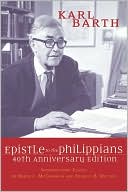
Karl Barth, Epistle to the Philippians

This interesting little commentary is one of the few examples of Barth's theological exegesis as it is applied to an entire book systematically. It doesn't rival other more traditional commentaries as far as exegetical insight, but it contains a number of gems, and reflects a deep and sustained engagement with the text. Barth illumines a number of theological themes in the letter in his own distinctive way, and, as is reflected by citations of this book in many modern commentaries, certainly makes a contribution to the understanding of Philippians. I most thoroughly enjoyed his discussion of Phil 3:8-9 and the subject of faith and righteousness. This brief discussion alone is worth the price of the book. While I won't be consulting this little commentary first or most frequently in future studies of Philippians, I certainly won't neglect it either, especially when looking at those more theologically dense passages.

William Webb, Slaves, Women & Homosexuals

I think it is fair to say that hermeneutics, and specifically hermeneutics as it relates to cultural anaylsis, is one of the most pressing issues facing the church today. How we understand Scripture to relate to its original culture and how we appropriate it in our own culture is one of the issues that is driving our current era of church history. How we understand issues such as those surrounding women and homosexuals are very live and important questions in our day. And this is why I commend William Webb's book as highly as I possibly can. He addresses these issues by carefully probing the underlying hermeneutical questions with thoroughness and and an irenic and humble spirit.

Webb begins by laying out the Christian's challenge with regard to these issues, "It is necessar for Christians to challenge their culture where it departs from kingdom values; it is equally necessary for them to identify with their culture on all other matters" (22, italics in original). This is difficult because though Scripture contains both culture-bound and transcultural elements, these would have been nearly indistinguishable to its original readers. The challenge, then, is to live out the spirit of the text without being too inseparably bound to the "isolated words." For Webb, this means undertaking a "redemptive-movement hermeneutic" as opposed to a "static" hermeneutic.

A redemptive-movement hermeneutic seeks to assess the "movement" of a text relative to its original cultural setting. It then moves into our own day and seeks to retain the same direction of movement relative to our current culture in places where our cultural setting has gone beyond that of the original culture. An explicit component of this assessment is that the Bible doesn't only contain an "ultimate" ethic, but often contains provisions, laws, and instructions that entail only a "partially realized" ethic. It is worth taking a second to look at the reasons Webb outlines for this to be so, because I don't think this concept is one most readers of Scripture consciously ascribe to. Webb asserts that God often inspired a "partially realized" ethic (1) for pastoral reasons, to stretch his people as far as they could go without snapping; (2) for padagogical reasons, to help people move from the known to a foreseeable future with enough continuity so they can find their way; (3) for evangelistic reasons, thus reform was intended to better social structures without being so radical as to jeopardize other aspects of the Christian mission; (4) to sustain competing values, such as upholding temporary values in pursuit of associated goods, such as slavery in service of social welfare or patriarchy in service to gender differentiation; and (5) for soteriological resons, to to deal with a fallen and sinful humanity to whom reform does not come easiliy and move us in a process of progressive sanctification.

Throughout the book, Webb sustains an argument that, taking the presence of elements of both an ultimate and a provisional ethic within Scripture (and he certainly acknowledges the presence of an ultimate ethic in Scripture), we must undertake careful cultural analysis to determine what components of Scripture are culture-bound and which are transcultural. Once this is done, we seek to uphold the transcultural components and seek to live out the culture-bound components through a process of "redemptive movement" where we seek to follow the redemptive spirit within the text by reapplying that same spirit to our own culture. Let's follow a similar flow to Webb's own argument to flesh this out a bit.

Webb argues that the neutral example of slavery provides an important case study for understanding how a redemptive movement hermeneutic works. The culture of the Ancient Near East and of the Greco-Roman world upheld a structure of slavery. The Bible, written within this culture, reflects this setting, in that it assumes the general structure of slavery. There are no explicit texts or passages that speak directly to the need for the abolition of slavery (except perhaps for Gal 3:28 and parallels); there are, on the flip side, though, many texts that assume that slavery exists. But many of these texts reflect a "redemptive movement," that is, they demonstrate a limited but real movement away from the worst abuses of slavery toward better and more equal treatment of slaves. This movement, when coupled with the ultimate ethic in Scripture that acknowledges the equality of all people before God and the need to love neighbor as self, points toward the need for further movement beyond the movement accomplished in the OT or NT. Thus, as we live out the spirit of these texts, we appreciate our different cultural setting and seek to move closer to the unrealized ultimate ethic of abolition of slavery, and even beyond this toward fuller workplace and economic justice.

Webb takes this same process of analysis into his discussion of texts surrounding women. In that cultural analysis, through the use of eighteen different criteria, he assesses the culture-bound components of patriarchy, relating to economic, social, and practical concerns. This analysis includes a careful exposition of the pertinent New Testament texts in their cultural settings, as well as a thorough discussion of the relation between the testaments on this point, and especially of the role played by Genesis texts in the discussion. He then couples this with an investigation of the ultimate ethic present in scripture, and concludes that the Bible moves toward a complementary egalitarianism or an ultra-soft patriarchy.

The third issue Webb looks at throughout the book is that of homosexuality. This is important in two respects. First, it is important because it is a vital issue in its own right, and second, because it is often related either positively or negatively to discussion of issues regarding women, usually to rhetorical effect. Thus, importantly, Webb demonstrates that the two issues, both needing careful cultural analysis, demonstrate opposite movements within Scripture. Whereas the patriarchy texts evidence a positive movement toward egalitarianism, the homosexual texts consistently demonstrate an absolute movement away from freedom to complete prohibition, and this movement is to be carried over into our own culture, albeit slightly modified.

William Webb's book is often cited and quoted in studies surrounding these important and divisive issues, and this is with good reason. I wish I had read this book years ago, and have deeply appreciated his hermeneutical insights. He shows how to recognize a redemptive movement in Scripture that acknowledges and appreciates the spirit of the text without being too bound to the "isolated words," by which he means the words taken in isolation from their cultural and canonical context. He demonstrates a genuine faithfulness to Scripture and an intense pursuit of God's truth and God's desire for our lives here in the in-between time, while also demonstrating how to carefully move beyond the bare words of Scripture in those cases when it is bound to its cultural setting. I look forward to appropriating his insights in future study. I must say that I also deeply appreciated his humble and irenic tone. He openly acknowledged the areas of greatest weakness in his own case (even writing a "What If I Am Wrong?" chapter to lay bare and discuss these weaknesses and their bearing on his case), and also sought to acknowledge the strengths of his opponents positions and demonstrated charitable readings of opposing views. All the same, I think he also admirably shows the promise of careful cultural analysis for faithful application of Scripture, in a convincing assessment of the issues surrounding both homosexuality and women. I also hope at the very least that this book dismantles the arguments often bandied about that those who favor women in ministry are on the slippery slope to accepting homosexuality or that those who accept women in ministry must make this subsequent move, as Webb demonstrates how this is clearly not so.

In all, this book is a landmark study of hermeneutics especially as it bears on these important issues, and is a must read for those on all sides of these pressing discussions. Do not miss this book, and do not delay.

December 04, 2008

Scot McKnight, The Blue Parekeet

Scot McKnight, well known blogger and author, challenges readers to think about how they read the Bible in this great little book. The challenge McKnight lays down to readers is to think about what it means to be "biblical" in our thinking, speaking, and acting. Though we may think we mean simply "doing what the Bible says," he shows us that for almost all of us, that is clearly not the case. Through some simple examples he shows that we all pick and choose what we apply and how. The question explored throughout the rest of the book, then, is why and how do we do this. He asserts that "adopting and adapting," a more positive spin on the phenomenon, is indeed the right way to read the Bible, as we seek to discern both how God spoke in the past and how God is speaking to us in our day in our way.

McKnight proposes a three-stage process in our reading and applying the Bible: Story, Listening, Discerning. The first case he sets out to make is that the Bible is fundamentally a Story, or more properly, a variety of retellings of the one Story: Creating Eikons; Cracked Eikons; Covenant Community; Christ, the Perfect Eikon, redeems; Consummation. That, in a nutshell (and in Scot's own distinctive terminology) is the story of the Bible. The 66 books of the Bible then make up "wiki-stories," retellings in often distinctive ways, with varying emphases and language in different times and settings, of this one overarching story. And here is one of McKnight's core assertions, these "wiki-stories" are tellings of God's truth "in Moses' days in Moses' ways . . . in David's days in David's ways . . . in Jeremiah's days in Jeremiah's ways . . . in Jesus' days in Jesus' ways . . . in Paul's days in Paul's ways . . ." He concludes that we are "called to carry on that pattern in our world today" (28). The key to this movement into our own days and ways is Story, as we recognize the story and its retellings in the Bible and seek to enter into that same story in our day.

The second section of the book takes up the second stage in our reading and applying the Bible: Listening. McKnight emphasizes that we listen to the Bible because we have a relationship with the God of the Bible. That relationship forms the ground and purpose of our reading and listening. He seeks to get past abstract discussions of the Bible's authority, past having a "view" of the Bible, as legitimate as these things may be, to focus on having "a 'relationship' to the God of the Bible" (95). This understanding then shapes our listening, as we listen attentively to and for God, we are attentive in recognizing God speaking, we absorb what God says and we act on what we hear (99). This puts a helpful emphasis on the way the Bible must shape us as we listen. We aren't just mining the Bible for "truth" or theology but we are encountering God speaking to us, and must act and react accordingly.

The third stage we encounter is Discerning. After we have recognized the story in the text and have listened attentively to God speaking through his Word, we must discern our part in the story, we must discern what we are then to do. Here he argues that the "adopt and adapt" strategy that all Christians implicitly or explicitly espouse is in fact the right idea. We must recognize that "that was then and this is now." But this is not simply a personalistic anything goes reading of Scripture, but is a discerning, with (as opposed to through) tradition, in community. We need to recognize that the Bible itself points toward a strategy of discernment, and that the church has likewise passed on this legacy of a "pattern of discernment" (118). McKnight acknowledges the messiness of the process, and that it means there will be disagreements. But, he writes, "it is the attempt to foist one person's days and ways on everyone's days and ways that quenches the Holy Spirit" (143). It is because of the gospel that we strive to adapt, just as Paul says in 1 Corinthians 9. We, like Paul, should be governed by what furthers the gospel the most (142). Thus, "Living out the Bible means living out the Bible in our day in our way by discerning together how God would have us live" (143, italics in original).

These three stages sketch McKnight's proposal for how we should approach and appropriate the Bible in our own day. The fourth part of the book provides an extended case study in this method, using the question of women in ministry as an example of "adopting and adapting." In this fourth part, he lays out a careful argument, beginning with what women did in the Old and New Testament times and in the Early Church, and with what the Bible says about women and ministry. He looks at how we can recognize the cultural distance between these past times and our own, but also focuses on how we can recognize the "story" in the Bible that spoke powerfully in past days and again in our own. Through this process, he makes the argument that discerning God speaking in the story of the Bible and discerning how God would have us act today, with a focus on the message of the gospel, leads to the full participation of women in the life and ministry of the church.

I thoroughly enjoyed this very readable introduction to how we read and apply the Bible. I have no doubt that almost all Christians could benefit from a book like this, as all too often we assume that we're being "biblical" without recognizing the complexities involved in our own positions. This little primer on hermeneutics is a great way for people in the pews to begin to come to terms with these important issues. But, importantly, this isn't a cause for consternation but for hope. Instead of being paralyzed by fear of the messiness of discernment, we should be energized by the gospel and our part in the story as we acknowledge the God of the Bible speaking to us even down to our own day. This book is clearly at an introductory level, as McKnight acknowledges along the way, but I think it agreeably whets the appetite for further study into these important questions. And I think it is a helpful introduction into the Bible as "Story," as we recognize the great divine drama into which we are called. I also enjoyed his case study on women in ministry. His arguments and his own personal journey make for very compelling reading. I think he shows beyond doubt that the church, at the very least, has restricted women beyond even the restrictions they faced in New Testament times, and he points toward a fuller inclusion of women in all areas of the church. While he obviously doesn't engage with the vast array of scholarship or the serious technical issues involved in the debate, his case study provides a great "egalitarian" introduction into the debate.

In all, I think McKnight's Blue Parakeet is an important guide to seeing the Bible as it really is and to recognize how we do and how we should read and apply it.