February 19, 2010

Stephen Mansfield, The Search for God and Guinness

Thanks to Thomas Nelson for the review copy. This book is, as its subtitle proclaims, "a biography" of a beer. But, it is obviously more than that. In short, it is the biography of a family and a company whose history is seasoned with devotion to Jesus Christ and to the conviction that faith can be lived out beyond the walls of a church. In this interesting and readable journey through 250 years of history, Mansfield writes an engaging chronicle of how this family's faith shaped the ethos of a company and led it to be a leader both in the quality of the product it produced and in the way it formed a corporate culture. I can't say I'd ever thought of beer as a particularly healthy drink (probably due to a lot of baggage that often comes with the beverage in its American context), but its value as a safe and wholesome alternative to either unsafe water or to harder liquor in the early years of the company was part of the motivation behind its beginnings.

I was fascinated by the way this company continually chose to be a leader in the way it treated its workers, from the way company doctors aggressively sought to improve the living conditions of turn-of-the-twentieth-century workers, to the preservation of jobs for people in military service during the second world war, to the high wages it paid. I was also intrigued by the pattern of heirs apparent sidestepping their path to the company for full-time Christian ministry.

In all, this was both an entertaining and informative study on how one family and company have lived out their faith. It certainly gives food for thought on how our corporate culture today often falls short, and it also proves a great extended illustration of Luther's emphasis that vocation goes far beyond ordained ministry.

February 05, 2010

Dietrich Bonhoeffer, Life Together

I highly recommend this classic work on the importance of Christian community. Coming out of his experiences in the Confessing Church seminary in the years leading up to WWII, Bonhoeffer's spectacular book both outlines the theological foundation for a robust and intentional communal life, but also gives practical advice on how to bring it about. While we certainly won't all be participating in the daily type of community that Bonhoeffer envisions (though it is very different from a cloister life, in that it is intentionally pointed toward and among the world in service), his vision is filled with great wisdom and insight for appreciating and reinvigorating our participation in our churches and smaller fellowship groups today. Teaching about Bible reading, prayer, service, and confession, Bonhoeffer paints a picture of the Christian life that preserves one from self-absorption and brings one into the support and fellowship of the communion of saints as we encounter Christ in one another. Truly a must-read.

February 03, 2010

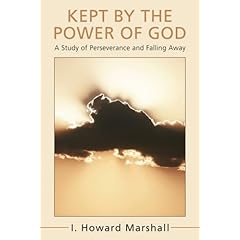
I. Howard Marshall, Kept by the Power of God

In this classic study (published originally in 1969 and republished with a new substantive epilogue in 1995), Marshall looks at a key theological issue in the New Testament, the perseverance of believers. In a setting of persecution, the question of perseverance is one that arises often in the NT texts, and it is an important pastoral issue still today. But it is also extremely useful as a lens through which to view the NT understanding of salvation, election, judgment, and many other interconnected ideas. In short, it is a vital test case, or maybe better put, it is essential data for a robust NT doctrine of God and of salvation.

Marshall digs in to the relevant NT texts by first investigating the OT and Jewish background concerning perseverance. He then moves through the various corpora in the NT: the Synoptics, Acts, Paul, Pastorals (may or may not be by Paul, but treated separately from though with an eye toward the undisputed Pauline corpus), Hebrews, the Catholics, and the Johannine literature. This systematic study is largely exegetical, as Marshall works carefully with the individual texts on their own before summing up each author's perspective.

Marshall then brings all of this data to bear on a conclusion: "We can say firmly that, while it is possible for a Christian to fail to persevere after a genuine experience of salvation, yet, with all the promises of a faithful God to sustain those who trust in Him, the main emphasis of the New Testament is on confidence and assurance of final salvation" (210). In short, while we can't explain away the possibility of falling away, believers may be "confident of persevering through the power of God" (199).

I am greatly appreciative of Marshall's study. I think it is a wonderful exegetical survey of this important area. And I think it provides an important testimony to the work of God in salvation. It obviously has much bearing on the Calvinist-Arminian debate (though Marshall prefers the designation "non-Calvinist" in this context because the second position isn't necessarily in conformity with Arminius). He has many insightful discussions of election, calling, monergism vs synergism, and some of the other relevant theological areas that are touched on by this topic. I greatly benefited from this book, and think Marshall has taken a robust, biblical line on the question of perseverance and, more broadly, on God's working in salvation.

December 20, 2009

Good as the privation of evil?

I've been focusing my reading on Pauline studies for the last year or so, and it's been a blast. One of the key issues that comes up again and again, in Paul's letters no less than in the vast literature they have spawned, is the meaning of righteousness, especially God's righteousness. So this has got me reflecting on what I think it is. I think, for many Christians, the answer would involve something revolving around God's holiness, understood as God's perfection and total absence of sin. It is something (akin to a pristine state, innocence) that God imparts to us as a gift. Now, I can't think of anything at all wrong with any of that (though I know some people would certainly quibble with it), but I also think it's woefully incomplete.

In Pauline studies, there is a big discussion of God's righteousness as understood objectively (a righteousness that God possesses and gives to believers) or subjectively (a quality or activity of God that brings about or entails or results in God's saving work). And while I think something of both positions carries valid and important truth, I think there is immense value in looking at God's righteousness subjectively, as something like God's faithfulness and his saving action. I think this helps us go beyond a perspective of good (held implicitly or explicitly) as that which is without evil (though that is a perfectly fine affirmation) to fill that most excellent category of God's righteousness with some amazing content: God's loving faithfulness, his saving grace, his patient purpose.

These few reflections certainly don't even begin to scratch the surface of the exegetical issues entailed in the discussion, but I hope they can be some valuable reflection on Christmas, and God's loving gift in sending his Son. For in Jesus God's righteousness is surely revealed.

December 14, 2009

Paul and Church Order—J. D. G. Dunn

Continuing my multi-author look at church order in Paul's letters takes me to James D. G. Dunn's perspective as displayed in the chapter, "Ministry and authority" in his massive Theology of Paul the Apostle. Dunn begins his characteristically thorough treatment with a survey of some of the nineteenth- and twentieth-century discussion around the issue, highlighting especially the discussion about the church structure mirrored in Paul's letters as one of "office" verses one of "charism," a debate which occurred largely in protestant circles but also emerged in Roman Catholic ones, especially as can be seen in some of the changes that took place in Vatican II. Dunn concludes that the importance of Paul's "charismatic" vision can't be questioned but that a further step must be taken, in looking at how Paul's churches actually implemented that vision, since his understanding of the church as a charismatic community shouldn't be taken as a complete ecclesiology or a complete set of instructions on church order.

Dunn's first step, after the historical survey, is to look at Paul's own apostolic authority and how it was exercised. A few insights prove helpful here. One is that Paul exercised his authority from within the community, to equip the community. Dunn observes that Paul exercises a lot of restraint in the use of his authority, rarely if ever calling for "obedience" to him but instead seeking to convince and persuade. A second salient point is that Paul sees even his own authority as subordinate to the gospel and limited in scope to his own apostolic commission.

With regard to other leaders in the congregations, Dunn makes a number of observations. One that is quite interesting is that apart from the possible mention in Phil 4:3, Paul makes no appeal to church leaders to fix a situation or handle a problem, nor does he rebuke the leadership for the failure of a church on a particular issue; instead he makes his appeals to the gathered assemblies in toto. While there are clearly people who take up certain roles or hold various leadership positions in his churches, Paul seems to envision his congregations as an integrated whole who are all responsible for these important matters. (The situation of the Pastoral Epistles is slightly different here; Dunn regards them as later developments in the Pauline tradition, but even considering them Pauline doesn't change the aforementioned situation too much since the type of authority being exercised by Timothy or Titus is more akin to Paul's own authority that it would be to that of a local elder or overseer.)

A second observation Dunn makes is that there is a careful interplay between charism and office, with the former spoke of more than the latter. Prophecy serves as a good illustration of this: Dunn asserts that "prophetic authority derived from prophetic inspiration," and "prophets didn't prophecy because they were prophets; they were prophets because they prophesied" (582). He goes on to assert that prophetic authority also wasn't limited to prophets (others could seek this gift as well), and further, that prophetic authority was subject to the assessment and discernment of others. The position of "teacher" functions similarly.

To me, this seems to mean that, while clearly envisioning a position of "authority" for those designated "prophets," this paints a much more fluid and interdependent picture of how that particular position worked than we might think of today, with categories like ordination and office being more natural and familiar to our thinking about church order.

Dunn concludes by reflecting that the canon includes both Paul's earlier letters and the later Pastoral Epistles, meaning we must hold the two together in some way, even though he sees somewhat divergent tendencies, but he concludes that while we the Pastorals show some level of routinizing and institutionalizing of the more charismatic structure evident earlier, the two elements can and must be held together.

Paul and Church Order—Gordon Fee

I have the privilege of participating in a great class on church eldership and leadership through my church, using curriculum from the Center for Church-Based Training in Dallas. And one of the issues we have been addressing early on has been the role of elders, specifically as seen in the NT. So I've been taking this opportunity to do a little reading on that particular subject. The first author I've dug into on this question has been Gordon Fee, from his book Listening to the Spirit in the Text, a spectacular collection of essays focused especially on things Pauline. In it he has two essays concerned with church order.

A few key emphases come up in Fee's discussions. The first is that Paul envisions leadership as something that is exercised from within the people of God (that is, the "laity") as opposed to something that was exercised from without, by a particular person or class of people set apart from that people (a departure, driven by christology and ecclesiology, from Israel's system of priests). Hand in hand with this emphasis is that leadership is envisioned much less (if at all) as exercising authority than as service: while it is true that churches are exhorted to submit to their leaders, the focus that emerges from Paul's vision of leadership is one of service to the body, exercising of spiritual gifting to build up and equip. A second key emphasis is on the distinction that must be made between "office" and gifting. Paul's concern with overseers and deacons seems to focus on the recognition of the Spirit's gifting of people in these areas and the congregation's role in discerning and recognizing that gifting. I would interpret this to mean much less focus on the particular "offices" that each church must fill and selecting the proper people to do so (though the latter is not necessarily an illegitimate enterprise, though it must be understood at least to some extent to be something that goes beyond the specifics of the text). A final emphasis that comes out in Fee's writing is the assertion that leadership at the local level seems to always have been plural: he is quite critical of a strong divide between "clergy" and "laity" at this point. (This last discussion is complicated some by the recognition that Paul envisioned two types of authority: an apostolic, itinerant sort that was exercised by the Jerusalem apostles, by Paul himself, and by his deputies Timothy and Titus, and a local authority established in each church.)

Fee's reconstruction of church order in Paul's writing is I think a very helpful corrective to some assumptions that many of us may bring to the text. Especially enlightening are his emphasis on the fact that "office" is of less importance than it is often accorded today. Fee is also very good on hermeneutics, and makes the point that Paul doesn't seem to be dictating a specific model of church order (that doesn't seem to be his concern) nearly as much as focusing on the character of leadership that is exercised. In a sense, that means many of our modern questions about how to organize a church are underdetermined by the evidence in the NT, though clearly there is much of relevance here. Thus, we must be careful to articulate and consider the question of the nature of the evidence we are given in these letters and how we transfer that information to our current context: how do we relate the "spirit" of the instructions to the "letter" of Paul's instruction, how do we travel from one cultural context to another, from one historical situation to another? And how does the setting and situation we infer from the text serve as God's authoritative word to us (if it does and to what extent) or how is it just the background into which that authoritative word functions. In short, these two essays provide a vast amount of food for thought, with deep exegetical insight paired with relevant hermeneutical reflection. They help us chasten our reading of the text by investigating our assumptions and also help us act as faithful members of God's people seeking to carry out God's will as expressed in his word for his gathered people.

November 21, 2009

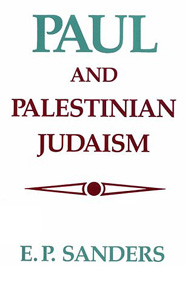
E. P. Sanders, Paul and Palestinian Judaism

Few books have impacted biblical studies in the past decades more than E. P. Sanders' Paul and Palestinian Judaism. This groundbreaking book has been instrumental in a reevaluation of many long-held presuppositions about Judaism at the time of Paul and Jesus, and about how Paul related to that heritage. I've long heard it referred to, cited, and criticized, so I thought it was finally time that I read it for myself. And I'm extremely glad I did.

First, a word about my reading, which was a bit selective. I chose to read the conclusions he draws at the close of the first two thirds of the book, dealing with his reevaluation of Judaism and his assertion of "covenantal nomism" as the overriding framework at the turn of the era. I then read the remainder of the book, dealing specifically with Paul and his relation to the Judaism of his day as reconstructed by Sanders. I'm not competent to comment on the foundational aspect of his thesis that Judaism is typified in Paul's day by covenantal nomism, that entry into the covenant was by God's grace and that works served to maintain that relationship as a way of staying in, other than to say it is obvious that Sanders was instrumental in awakening a reappraisal of the sources and a questioning of some long-held assumptions. I have found it to be a compelling argument, even if not completely convincing on all counts.

His chapters on Paul are uniformly well written and well argued. His foundational claim is that Paul reasoned from solution to plight, and not the other way around, so that the driving force in Paul's thinking was not what was wrong with Judaism or the Law or with humanity in general, but instead by his conviction that Jesus Christ is Lord and is the only way for salvation. This basic premise causes a reevaluation of Paul's thought process and illuminates Paul's thinking in a fresh way. Instead of focusing on justification by faith as the peak of Paul's theological reasoning (his "pattern" of religion in Sanders' terminology), participation with Christ moves more toward center stage. It is the need of Jesus Christ as Lord that is the decisive factor in his distancing himself from Law observance: not that it is futile or wrong-headed or unable to attain righteousness, even if these are also his conclusions, but first and foremost that it isn't focused on Jesus Christ as Lord. His focus on the participationist stream of Paul's thinking is especially enlightening, as he shows how important the theme of dying with Christ is to Paul's understanding of salvation. In his discussion of works, Sanders asserts that "Salvation by grace is not incompatible with punishment and reward for deeds," (517) and that is the position he asserts as Paul's. With regard to covenantal nomism, he says that Paul's view of works is in perfect agreement (518) with the Judaism of his day, but (and this is an important qualifier) Paul's pattern of religion is fundamentally different than covenantal nomism. He stresses this a number of times, asserting that while there is substantial agreement, there is a basic difference (548). That difference is Christ. Paul's pattern of religion, described as "participationist eschatology," is typified by participation in Christ, a change in lordship from the lordship of the flesh or sin to Christ, and being under grace instead of under the law. It is a transfer that takes place, and that is decisive. Even though Paul does spend a good bit of time talking about the role of works, and is rightly concerned with justification by faith, which Sanders includes in his scheme, it is Christ that takes center stage, and union with Christ that is the driving force of his thought. Anything that is pointing toward a different goal is entirely useless, and thus the observance of the Law in order to obtain righteousness is not so much destructive or in need of reformation as it is working in a totally different order than union with Christ.

Even though his discussion of Paul isn't much more than a hundred pages, this short review can only scratch the surface of this seminal work. I came to it with a pretty good acquaintance with many critiques of Sanders' work, and I look forward to continuing to sift this great piece of reasoning and argument. At the very least, it is abundantly clear that he has brought to light a number of themes in Paul that are too often underplayed or subordinated (such as participation or lordship), or at least, that were until after he published this study. I look forward to continuing to study Paul's theology and soteriology, and this important work is clearly one of the indispensable stopping points along that way.

November 01, 2009

Michael Gorman, Inhabiting the Cruciform God

In this study of Pauline soteriology, Gorman focuses on Paul's "grand narrative" of kenosis, justification, and theosis as key themes for understanding Paul's view of salvation in Christ. The key text for explicating the narrative is Phil 2:5-11, where the kenosis and exaltation of Christ form the key movements in the description of Christ's incarnation. For Gorman, this narrative is key to understanding Christ, and salvation, and even more, it is key to understanding God. He sets as one of the book's key agendas the claim that "cruciformity is theoformity, or theosis," built on the foundational claim that "kenosis (self-emptying) reveals the character of God" (2). This key element of the thesis is worked out in the first chapter of the book, with a careful study of Philippians 2 and it's implications for Paul's master story. He then turns to an extended study of justification as co-crucifixion, a participation in the life and death of Christ, and specifically in Christ's covenant fulfillment. (Thus, the pistis christou debate features prominently in the chapter, as the subjective genitive reading there is an important element in the argument, though it doesn't stand or fall solely on that point.) He then turns to holiness as the actualization of justification (not some subsequent and separate movement) and closes with an argument for nonviolence as an essential part of Paul's entire viewpoint.

I greatly enjoyed Gorman's important work. It is well written and clearly argued throughout, and he demonstrates a thorough familiarity with Paul and his letters. I am extremely sympathetic to the core theological argument of the book, that kenosis not only pertains to Christ but also reveals something of the character and manner of working of God the Father as well. His chapter on justification is likewise illuminating, and I think he is convincing that theosis (as he carefully defines it) is an element in Paul's soteriology, one that is often neglected in the Western tradition. Whether "justification by co-crucifixion leading to theosis" is the one soteriological model for Paul is most certainly a more difficult argument to pull off, but at the least Gorman has demonstrated how the "crucified with Christ" language and thought patter in an important one for Paul. His chapters on holiness and nonviolence are similarly thought-provoking and challenging, and I have no doubt that this work overall provides an argument to be reckoned with. Gorman constantly brought me back to the text of Paul's letters to notice details I had previously missed while at the same time making a synthetic argument for an overarching framework that is helpful in thinking like Paul thought. So while I may not agree with him in all particulars, this is clearly a great work, and I am glad to recommend it.