February 21, 2008

Craig Allert, A High View of Scripture?

In A High View of Scripture?, Craig Allert, Professor at Trinity Western University in British Colombia, takes a considered look at the formation of the New Testament canon with a view to what it says about the evangelical doctrine of Scripture. Many evengelicals have what he describes as a "dropped out of the sky" view of Scripture, and Allert undertakes a careful historical investigation into the formation of the New Testament that takes seriously its development. It would be difficult to rehearse all of the discussions that Allert sets out on in a brief review, but after a very short lay of the land he covers, we'll look at a couple of important points he repeatedly stresses.

Allert begins by looking at how canon plays a role in evangelical doctrines of scripture, and what understandings of canon formation are utilized for this task. He then drills down and discusses the process of canon formation over the first centuries of the church, focusing in turn on the criteria that were in evidence as the various books were selected, the various heresies that brought challenges to the developing orthodoxy, and the various "canon lists" that evidenced the growing consensus. He then concludes with a discussion of how the process of canon formation as it is thus brought to light bears on the understanding of inspiration.

A few important insights are worth mentioning. First and most basic is the recurring theme throughout the book (and also of the series, Evangelical Resourcement, to which the book belongs) that the Bible came into being in the context of and for the use of the church. Thus, a doctrine of "sola scriptura" must be carefully formulated to maintain the Bible as the foundation of theology without divorcing the Bible from its rightful place in the community of believers past and present. A second important insight is methodological: often in canon discussions, "Scripture" is equated with "canon." Because the church fathers may have referred to various books as Scripture does not require that they were viewed as canonical. In fact, he demonstrates that there wasn't really a "canon consciousness," that is, an understanding that there was an authoritative list of normative Christian Scriptures, until the fourth century. Instead, "Scripture" designated something important about viewing a document as authoritative and normative, but not necessarily in the more restricted sense of canonical. In fact, the term and idea behind "canon" instead functioned in the early church with regard to a body of teaching or standard of behavior. A third insight has to do with the often assumed role of heresies in the formation of the canon. It is usually argued that the church developed canon lists in response to heresies that challenged the church's orthodoxy, but Allert shows that while this may have been a minor stimulus, there isn't found an increase in canon lists in response to early heresies. And he further shows that more at issue than which documents were authoritative was how to understand and interpret them. It was the church asserting the centrality of orthodoxy and apostolic teaching, not the selection of some documents over others, that formed the core of the church's response.

Allert strongly asserts that the process of canon formation as it actually occurred doesn't undermine the inspiration of Scripture. But his historical investigation does show that the early church didn't restrict "inspiration" to documents alone, and thus didn't restrict inspiration to the documents that later became the Bible. This doesn't undermine understanding the Bible as a collection of inspired documents (Allert emphasizes that this understanding is certainly true) but it does call evangelicals to have a broader and more nuanced understanding of what inspiration is and what that means for the Bible as an inspired document. I highly recommend this book as a great historical discussion of the issues surrounding canon (issues far too often ignored or caricatured in many discussions), and also a well-reasoned reflection on the implications of this discussion for how we understand the Bible. Allert has demonstrated great commitment to discovering the historical realities surrounding the New Testament's collection, and he has also showed that the truth is not something we have to fear, for instead of undermining our view of Scripture, it can reinvigorate it. For if the Bible is in fact the Word of God, understanding the truth about how it came to be can only help us to better understand it better.

February 15, 2008

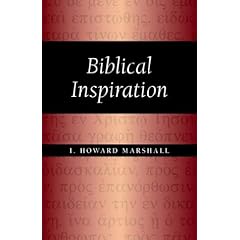
I. Howard Marshall, Biblical Inspiration

I. Howard Marshall is one of the most respected evangelical biblical scholars of the past generation, and in this short book, Biblical Inspiration, he undertakes a careful and balanced investigation into the nature and authority of the Bible. The book is simply laid out in six chapters:
Introduction: the Problem
1. What does the Bible say about itself?
2. What do we mean by inspiration?
3. What are the results of inspiration?
4. How are we to study the Bible?
5. How are we to interpret the Bible?
6. What are we to do with the Bible?

Through this simple progression, Marshall lays out the logic behind a robust doctrine of scripture, based on its character as God's inspired word. He begins by looking at what the Bible claims about itself, starting with the way Jesus and the authors of the New Testament understood the documents that came to be the Old Testament, and finding that they considered them, from the parts that are prophetic words from God to the historical narratives, to be God's Word, a view that culminates in the assertion in 2 Timothy that Scripture is inspired by God. He then moves on to investigate just what this inspiration is. He looks at different understandings, from a "dictation" model of inspiration to the view that the Bible is "inspired" just like good literature, finally asserting what he describes as a "concursive" model of inspiration. This asserts that human writers wrote the documents that have become our Bible, but that in so doing these documents are from God and are fully adequate for his purposes. He then moves on to look at the "results," that is, the implications of this understanding for what we understand the Bible to be. He concludes, after carefully weighing a number of options, and weighing them against the nature of the Bible as we have it, that the Bible is God's infallible word that is trustworthy to accomplish all that God intends. This can include "inerrancy," though the definition of that contested term must be very carefully laid out so that it takes into account the type of literature and the setting in which the Bible was written.

Marshall then proceeds to defend the "grammatico-historical" method of carefully studying the Bible, asserting that careful exegesis is necessary to better comprehending the message and meaning in the Bible. He then extends this discussion by describing how the fruit of this labor must be translated into our modern world, a world both similar to and distant from the world of the Bible, with an emphasis that the Bible must be its own norm and that we must always carefully guard against our own presuppositions and biases, even as we carefully analyze the Bible's message and seek to apply it. He concludes with a call to recognize and submit to the Bible's authority, based on its truthfulness.

Even though this is a short book, I have only skimmed the surface of Marshall's clear and helpful writing. He undertakes a very difficult and contested topic with great skill and profound insight. The result is a balanced yet also bold statement of the Bible's inspiration and authority. He provides some great correctives to especially a "dictation" model of inspiration and the attendant "inerrant" understanding of scripture that focuses almost solely on the Bible's divine character, and clearly this is a dialogue that he has in view with his writing. In short, I highly recommend this book as a short, clear statement of an evengelical doctrine of Scripture.

February 14, 2008

Homosexuality, science, and theology

I listened to a really informative lecture last night by Stanton Jones, Provost and Professor of Psychology at Wheaton College and Graduate School. In it, he looks briefly at the theological issues involved in the modern discussions surrounding homosexuality and homosexual practice, and then delves much more deeply in to what modern psychology has to say. He looks at a number of scientific studies, plumbing the depths of what they say and don't say, and exploding a number of myths about what "science says." This informative lecture is well done, and is by an expert in the field of psychology, who is a member of the American Psychological Association and was a member of its Council of Representatives. Thus, he speaks as someone with very good credentials in psychology.

January 23, 2008

Richard Bauckham, Jesus and the Eyewitnesses

Jesus and the Eyewitnesses is a ground-breaking study by NT scholar Richard Bauckham that questions many of the assumptions current in much New Testament scholarship today, especially about the formation of the Gospels. In this seminal book, Bauckham makes a sustained case for the involvement and centrality of eyewitnesses in the formation of the Gospels as they appear in their current, written canonical form. I won't attempt to recreate his arguments here, for they are many and detailed, but he covers evidence from other ancient historiographies about method, he looks at the statistical prevalence of names in the Gospels verses their known prevalence in the ancient world, and he studies the literary cues from within the Gospels themselves. He also looks very carefully at the earliest testimonies from outside the Gospels about their origin, espeically Papias, Eusebius, Iranaeus, and Polycrates.

A second major thrust of all of this, and maybe the most essential part of the entire book, is his sustained case, summarized and carefully argued in chapter 11, "Transmitting the Jesus Traditions, but supported by work in other chapters as well, is an alternative account of the origin and transmission of the traditions about Jesus and how they came to be written down. It is essentially a sustained (and I believe devastating) critique of form criticism, with its assumption of a long history of traditions and anonymous transmission of various "forms." His critique of form criticism is many-fold, but a few of its highlights are the emphasis on the relatively short period of time between Jesus' life and the writing of the Gospels, and even more especially, as the title of the book betrays, on the involvement of guarantors of the various traditions, which remained in many or even most cases, connected with certain named and known individuals.

He then spends a significant bit of the later portion of the book focusing on issues of authorship in John's Gospel, helpfully illuminating the history of scholarship about authorship, and looking carefully at the claims made by John's author, and also by looking at the early evidence, especially in Polycrates and Papias, about who this certain John was, concluding that the author of John was John "the Elder," a different John than the son of Zebedee, and that this John is in fact the beloved disciple, who later lived in Ephesus, and whose testimony was know at second hand by Papias, and who wrote down his account in his Gospel.

I estimate Bauckham's work to be a monumental achievement of scholarship, and I am hopeful that it will make significant waves in Gospels scholarship in the coming years. It is certainly a force to be reckoned with. Now, I don't expect all of his proposals will meet immediate approval by the guild, but I do think the broad scope of his argument, espeically as to the weakness of many of the assumptions linked with form criticism and still mostly current in Gospels scholarship today, even if beneath the surface, will help bring to light the need to reevaluate the types of documents that the Gospels in fact are. While Bauckham certainly doesn't provide evidence to in some way guarantee the accuracy and validity of the Gospels, he does give a very compelling case for linking the documents with certain named eyewitnesses, including but certainly not limited to the Twelve, among others. It is a very interesting and readable offering in NT scholarship, and one that I highly recommend. I think, along with works like J. D. G. Dunn's Jesus Remembered, Bauckham's work will help continue turning the tide toward reevaluating the relationships between the Gospels themselves and the nature of their development.

January 21, 2008

Theological Persuasion quiz

Hmm. Interesting little exercise.


What's your theological worldview?
created with QuizFarm.com
You scored as Evangelical Holiness/Wesleyan

You are an evangelical in the Wesleyan tradition. You believe that God's grace enables you to choose to believe in him, even though you yourself are totally depraved. The gift of the Holy Spirit gives you assurance of your salvation, and he also enables you to live the life of obedience to which God has called us. You are influenced heavly by John Wesley and the Methodists.


Evangelical Holiness/Wesleyan


82%

Neo orthodox


68%

Emergent/Postmodern


57%

Reformed Evangelical


54%

Fundamentalist


36%

Charismatic/Pentecostal


36%

Classical Liberal


32%

Roman Catholic


32%

Modern Liberal


11%


January 18, 2008

Gordon Fee, Paul's Letter to the Philippians

Paul's Letter to the Philippians by Gordon Fee is in the New International Commentary on the New Testament (NICNT) series published by Eerdmans. In this important commentary on this gem of a letter, Fee delves deeply into Paul's thought and Paul's world. I deeply enjoyed reading Fee's exposition, and was continually challenged by Paul's deep faith and his unflagging focus on Jesus Christ.

Fee surveys the important issues in the interpretation of Philippians, in constant dialogue (mostly in the notes) with other important commentators, and especially with O'Brien (NIGTC on Philippians), Silva (BECNT on Philippians), R. P. Martin, and Karl Barth, to name a few. But his commentary never gets bogged down in scholarly minutia. While he engages the pertinent issues, he almost entirely leaves his thoughtful technical discussions for the notes, where interested parties can easily find them, but where they can be left to the side to keep the focus on Philippians itself.

Fee looks at the question of the setting of the letter, and leans toward the more traditional view of Paul's Roman imprisonment as the setting (as opposed to either Caesarea or Ephesus, the latter of which has gained a good bit of attention in recent years), though the decision doesn't have much significance for understanding the letter itself. Of the more substantive matters in the letter, the "Christ Hymn" in Phil 2:5-11 has gained a mountain of scholarly attention, and Fee's careful discussion of that passage is insightful and fresh. He argues, against the tide of most modern scholarship, that the "hymn" really isn't a hymn at all, but a Pauline composition integral to the letter, even if poetic in form. And above all, he stresses that regardless, it should be treated as fully endorsed by Paul and integral to the letter, wherever one stands on its origin: Paul included it here for a reason, and it wasn't merely to give us a window into earlier hymnody.

With regard to the interpretation of the letter as a whole, Fee argues that it is a letter of friendship, and that this designation illumines many of the discussions throughout the letter, and especially the more "formal" elements at the beginning and end. This friendship can also be seen throughout in what he describes as a three-way bond between the Philippian believers, Paul, and Christ, which informs many of Paul's discussions and admonitions. As to the content of the letter itself, Fee sees steadfastness (in face of persecution and trial), unity (in face of challenges both within and without), and the unswerving focus on the gospel (living in Christ through the Spirit) as the three recurring themes and ongoing emphases throughout the letter.

There is far too much to comment on in a short review, but this great book deserves reading from cover to cover. Philippians, though not often seen as integral to understanding Paul's theology, is a very important window into Paul's heart. This volume is a great study of this short letter. It also reminds me that I really enjoy the NICNT series. It has great in-depth study of the text and the important exegetical issues, while keeping the discussions of Greek words to the notes. And the authors usually include a relatively brief reflection on the continuing significance or application of a passage to today at the end of each section. This volume, by the current editor of the series, shows why this tends to be the first place I go for NT scholarship.

December 09, 2007

Donald Bloesch, A Theology of Word and Spirit

A Theology of Word and Spirit is the first volume in Bloesch's Christian Foundations series, a seven-volume systematic theology. In it he outlines the methodology behind his theology, looking at a umber of important issues in the way theology is done.

Bloesch takes on some very important theological issues in this opening volume of his series, such as the role of rationality and the mind in faith and the place of natural theology. His discussions are much too comprehensive to simply summarize here, but we can at least illumine a few of his main themes. One of the most important is his understanding of the role of the mind in faith, what he calls "fedeistic revelationalism," a position that intentionally stands between "fedeism" (faith is an act of the will apart from rational thought, or in fact an irrational decision) and "rationalism" (faith is a reasoned decision based on the evidence). For Bloesch, both of these positions preserve important facets of how we believe, but also distort the truth of the gospel. Bloesch emphasizes that faith is a response to God's revelation, not simply a summing up of the evidence, nor a decision that is made completely without warrant. God's Spirit plays a key role in this whole process. This points to another important theme in Bloesch's theology, that it is a theology "of Word and Spirit." He is committed to a theology that is anchored to God's Word, Jesus Christ, revealed in Scripture, and always gives full credit to the moving of God's Spirit, who illumines God's words and guides God's people. This makes for a theology that is Christ-centered, Scripture-based, and always sensitive to God's Spirit.

Bloesch is a "mediating theologian," an evangelical that finds himself in between the progressive theology of liberalism and the conservatism of much evangelical theology. In his irenic theology, he dialogues with both, but points out extremes and misunderstandings in both systems of theologizing. His theology shows much evidence of the stamp of Karl Barth, and in many ways it is an "evangelical" morphing of Barth's theology, especially as it is an outworking of Barth's threefold doctrine of the Word of God. In many ways, I think this is a profound strength, in carrying out a profoundly evangelical theology that is based on God and his revelation found in his Word, instead of based primarily on a rationalistic doctrine of Scripture. Bloesch can uphold the importance of Scripture as a locus of God's revelation and the norm for theology without flirting with bibliolotry. How successful he is will have to be decided after a more careful look at the second volume of his Christian Foundations on Holy Scripture.

Over all, Bloesch's A Theology of Word and Spirit is a very worth-while exercise in theology. It gives evidence of a lifetime of prayerful reflection on these things, and is truly a mature theology that is aware of the great thinkers of theology through the centuries.

November 13, 2007

Scot McKnight, Jesus and His Death

In Jesus and His Death, Scot McKnight undertakes a historical look at how Jesus understood his own death. He begins with a study of the "historiography" of Jesus studies, looking at the historical methods currently in use, often in the background, in studies about Jesus and the New Testament, broadly categorizing them as modernist or postmodernist in orientation. After surveying this turf, he goes on to investigate how Jesus' death has been understood in modern studies of Jesus, largely concluding that in many cases Jesus' death is a neglected or at least under-emphasized facet of his life. (Which, this seems odd considering it's prominence in Paul's theology; though on the other had that might partly explain it, considering the orientation of many of the Jesus studies these days.) He then goes on in chapter three to "reclaim" Jesus death as an important focus of study.

Part two of his book is an initial investigation into the role Jesus' death played in h is life. He begins by looking at the question of whether Jesus expected a premature death, concluding minimally that after John the baptizer's death, it couldn't have been far from Jesus mind; that is, his own death was a possibility. But he begins building from that point by moving on to consider whether Jesus considered it more than mere possibility, but also a probability; was it something he expected? To investigate this question, McKnight surveys many strands of the Gospel narratives, making the argument that though Jesus didn't want to die, he came to see it as a likely outcome of his ministry, and that he expressed this as having a "temporary presence" with his disciples, and further, that he saw his likely death as part of the Final Ordeal, infusing it with eschatological significance, even to the point of seeing his death as representative for his followers.

Part three of McKnight's study focuses more specifically on how Jesus understood his own death as atoning, and specifically if he understood it as a ransom. This focuses the discussion on Mark 10:45, the saying about Jesus' death being a ransom for many. In this investigation he looks at allusions to Isaiah, the context of the saying, and many other factors in evaluating the authenticity of the saying. And the verdict isn't clear. The possibility that it is a later addition is strong. So this leads McKnight to investigate the remainder of the Jesus tradition to see if the saying gains support from other places as something Jesus would have said. This includes looking at how Jesus understood his own role (was it like Isaiah's servant, a role that would point toward "ransom" language or more like a son of man or some other mold?), concluding that servant imagery didn't play a prominent role in Jesus' self-understanding, but that son-of-man imagery was prominent. His investigation continues, with studies of other "scripture prophets" to whom Jesus can be compared, and with the passion predictions. Then, in part four, he undertakes an in-depth study of the last supper traditions, to shed some light on how Jesus understood his life and death.

Ultimately, McKnight concludes that the ransom saying in Mark 10:45 is likely a Markan gloss, and that Mark indeed understood Jesus' death as a ransom for many, paying the price to liberate Jesus' followers from a hostile power. So what of Jesus and his death? His first emphasis is that "Jesus' mission is more than a 'mission to die'" (336). Though it indeed turned out to also be that. Jesus called on God to avoid his upcoming death, but ultimately saw it as his own role in God's providence. So what of atonement? Jesus saw his death as a representative death, having value for his followers, and probably even as vicarious, taking the place of others. This is intimately caught up with the fact that his death was part of the "Final Ordeal," the inbreaking of God's kingdom into the present and the fulfillment of God's plans for the world.

But more must be said. The early church didn't confine it's reflection of Jesus' death to these themes, but plumbed the depths of Scripture and reflected on Jesus' life and death to come up with deep, rich, and varied expressions of the significance of Jesus death. And McKnight finishes up his book surveying these developments. In the end, he points beyond the "how" of atonement to the "whereunto": "the design of the atonement," he writes, "is to create a community, an ecclesia, a koinonia, a zoe, a new creation" (371). That is where he sees the center of the New Testament's message about Jesus and his death, a message that goes back to Jesus himself. Jesus death "would protect them, liberate them, and usher them into the kingdom of God" (372). That's a pretty robust place to start in reflecting on the atonement.

I still have some digesting to do of this one. It is a great book, and quite an enjoyable read for being a careful academic study. He does a very good job of making the reader aware of the large themes in the New Testament, while also zeroing in on important passages. It was a little disconcerting, though, to have so many traditional sayings of Jesus dismantled and dismissed, at least as they go back to Jesus. His judgment at times seemed a bit tentative when it came to authenticating sayings, but that may also give the book its value, as it provides a very strong foundation upon which to build an understanding of Jesus' death: Jesus thought of his death in these ways, at least. McKnight is a gracious scholar with a passion for teaching, and I deeply appreciated this book, though it has also challenged my thinking, but also driven me to think more deeply about many important issues. With so many debates ranging today about atonement theories and atonement thinking, this book provides an important voice in the larger discussion.