March 28, 2008

Wright on the Resurrection

CT has a great article by N. T. Wright on Heaven and the resurrection. It is a great condensation of his numerous thoughts and studies on this topic. He advocates, to put it simply, that the common popular focus on life after death as simply consisting of going to heaven or hell, as too simplistic, failing to take into account that there is instead an intermediate state that will one day lead to "life after life after death," a bodily resurrection in the mold of Jesus' resurrection, with a renewed existence on earth. This means that the bifurcation of the "gospel" of going to heaven after you die from "doing good in the world" is a false choice that is instead united in a robust eschatology.

March 21, 2008

Mark Noll, The Civil War as a Theological Crisis

The Civil War as a Theological Crisis is The Steven and Janice Brose Lectures in the Civil War Era, delivered at the University of North Carolina, and as a book that came out of a series of lectures, it has a relatively conversational and approachable tone. Mark Noll is an eminent historian of Christianity and specifically evangelicalism in America. In these lectures, Noll looks at the theological issues, which Noll argues in fact constituted a theological crisis, that shaped the Civil War and informed the views of politicians and the populace on both sides of the conflict. Noll begins by setting the stage with a look at the role of religion in American public life in the years leading up to the War, and especially at the role the Bible and its interpretation played. He then looks closely at "The Crisis over the Bible," the differing interpretations of various passages in the Bible, especially over the issue of slavery, that contributed so profoundly to the theological divide in the country. This chapter forms the core of the book, as he looks at competing interpretations of the Bible and the methods and assumptions that led to these conflicting interpretations. This then leads to a discussion of "the negro question," a look at the role race played in the discussions, either implicitly or explicitly. He shows that at the root, deep-seeded racism lay behind many of the defenses of slavery, and ignorance of the importance of the race issue weakened many of the opponents' arguments. It is crystal clear that the Civil War was a war with race issues at the center, though Noll emphasizes equally strongly that the picture is far more complex than a simple bifurcation of the country with the North fighting some type of righteous struggle on behalf of equality and the South fighting a bigoted battle to preserve the status quo.

Noll's discussion then turns to a look at what role providence played in the preaching and thinking about America's destiny and the racism and slavery that were at issue. He writes that "confidence in the human ability to fathom God's providential actions rose to new heights." Many on both side presumed to know God's will and intention in and for America. By the end of the war, this view was strongly chastened, and Noll points to a connection between arguments concerning providence before and during the war and the movement of religion to the "private" sphere after the war. After these substantive discussions, Noll takes an informative look at views of Protestants and Catholics abroad, and takes stock of these perspectives that give a different view point on the happenings in America.

I found Noll's book to be compelling and important reading. I think his careful appraisal of this important conflict over the role and interpretation of the Bible needs to inform evangelical approaches to Scripture today. I think one of the clearest lessons needs to be a chastening of our American and Protestant impulse to read and interpret the Bible on our own, without recourse to church or magisterium, and often without regard for history. Along with this goes a strong warning against assumptions of the simplicity of the Bible's message. Throughout the era leading up to and including the Civil War, defenses of slavery had an easier time convincing much of the American public, often largely because of the simplicity of its arguments and the fact that it drew on "plain" and surface readings of the Biblical text. Readings that opposed slavery often incorporated more nuanced and historically couched arguments. For many, this went against their protestant and American sensibilities and assumptions.

It would seem that this book, and this historic situation, has much to say to our modern-day church, and to the evangelical church in particular. Issues such as the church's stance on women in ministry or the status of homosexuals can be well informed by this discussion. That is certainly not to say that the historic move to condemn slavery should or could be directly applied to the acceptance of women in ministry or the full acceptance of homosexual activity, but this careful historical discussion provides some important context in which to judge our approaches to Scripture. It also rightly calls us to examine our assumptions that we bring to the Bible. I highly recommend it.

February 21, 2008

Craig Allert, A High View of Scripture?

In A High View of Scripture?, Craig Allert, Professor at Trinity Western University in British Colombia, takes a considered look at the formation of the New Testament canon with a view to what it says about the evangelical doctrine of Scripture. Many evengelicals have what he describes as a "dropped out of the sky" view of Scripture, and Allert undertakes a careful historical investigation into the formation of the New Testament that takes seriously its development. It would be difficult to rehearse all of the discussions that Allert sets out on in a brief review, but after a very short lay of the land he covers, we'll look at a couple of important points he repeatedly stresses.

Allert begins by looking at how canon plays a role in evangelical doctrines of scripture, and what understandings of canon formation are utilized for this task. He then drills down and discusses the process of canon formation over the first centuries of the church, focusing in turn on the criteria that were in evidence as the various books were selected, the various heresies that brought challenges to the developing orthodoxy, and the various "canon lists" that evidenced the growing consensus. He then concludes with a discussion of how the process of canon formation as it is thus brought to light bears on the understanding of inspiration.

A few important insights are worth mentioning. First and most basic is the recurring theme throughout the book (and also of the series, Evangelical Resourcement, to which the book belongs) that the Bible came into being in the context of and for the use of the church. Thus, a doctrine of "sola scriptura" must be carefully formulated to maintain the Bible as the foundation of theology without divorcing the Bible from its rightful place in the community of believers past and present. A second important insight is methodological: often in canon discussions, "Scripture" is equated with "canon." Because the church fathers may have referred to various books as Scripture does not require that they were viewed as canonical. In fact, he demonstrates that there wasn't really a "canon consciousness," that is, an understanding that there was an authoritative list of normative Christian Scriptures, until the fourth century. Instead, "Scripture" designated something important about viewing a document as authoritative and normative, but not necessarily in the more restricted sense of canonical. In fact, the term and idea behind "canon" instead functioned in the early church with regard to a body of teaching or standard of behavior. A third insight has to do with the often assumed role of heresies in the formation of the canon. It is usually argued that the church developed canon lists in response to heresies that challenged the church's orthodoxy, but Allert shows that while this may have been a minor stimulus, there isn't found an increase in canon lists in response to early heresies. And he further shows that more at issue than which documents were authoritative was how to understand and interpret them. It was the church asserting the centrality of orthodoxy and apostolic teaching, not the selection of some documents over others, that formed the core of the church's response.

Allert strongly asserts that the process of canon formation as it actually occurred doesn't undermine the inspiration of Scripture. But his historical investigation does show that the early church didn't restrict "inspiration" to documents alone, and thus didn't restrict inspiration to the documents that later became the Bible. This doesn't undermine understanding the Bible as a collection of inspired documents (Allert emphasizes that this understanding is certainly true) but it does call evangelicals to have a broader and more nuanced understanding of what inspiration is and what that means for the Bible as an inspired document. I highly recommend this book as a great historical discussion of the issues surrounding canon (issues far too often ignored or caricatured in many discussions), and also a well-reasoned reflection on the implications of this discussion for how we understand the Bible. Allert has demonstrated great commitment to discovering the historical realities surrounding the New Testament's collection, and he has also showed that the truth is not something we have to fear, for instead of undermining our view of Scripture, it can reinvigorate it. For if the Bible is in fact the Word of God, understanding the truth about how it came to be can only help us to better understand it better.

February 15, 2008

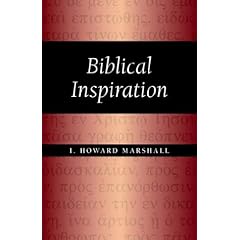
I. Howard Marshall, Biblical Inspiration

I. Howard Marshall is one of the most respected evangelical biblical scholars of the past generation, and in this short book, Biblical Inspiration, he undertakes a careful and balanced investigation into the nature and authority of the Bible. The book is simply laid out in six chapters:
Introduction: the Problem
1. What does the Bible say about itself?
2. What do we mean by inspiration?
3. What are the results of inspiration?
4. How are we to study the Bible?
5. How are we to interpret the Bible?
6. What are we to do with the Bible?

Through this simple progression, Marshall lays out the logic behind a robust doctrine of scripture, based on its character as God's inspired word. He begins by looking at what the Bible claims about itself, starting with the way Jesus and the authors of the New Testament understood the documents that came to be the Old Testament, and finding that they considered them, from the parts that are prophetic words from God to the historical narratives, to be God's Word, a view that culminates in the assertion in 2 Timothy that Scripture is inspired by God. He then moves on to investigate just what this inspiration is. He looks at different understandings, from a "dictation" model of inspiration to the view that the Bible is "inspired" just like good literature, finally asserting what he describes as a "concursive" model of inspiration. This asserts that human writers wrote the documents that have become our Bible, but that in so doing these documents are from God and are fully adequate for his purposes. He then moves on to look at the "results," that is, the implications of this understanding for what we understand the Bible to be. He concludes, after carefully weighing a number of options, and weighing them against the nature of the Bible as we have it, that the Bible is God's infallible word that is trustworthy to accomplish all that God intends. This can include "inerrancy," though the definition of that contested term must be very carefully laid out so that it takes into account the type of literature and the setting in which the Bible was written.

Marshall then proceeds to defend the "grammatico-historical" method of carefully studying the Bible, asserting that careful exegesis is necessary to better comprehending the message and meaning in the Bible. He then extends this discussion by describing how the fruit of this labor must be translated into our modern world, a world both similar to and distant from the world of the Bible, with an emphasis that the Bible must be its own norm and that we must always carefully guard against our own presuppositions and biases, even as we carefully analyze the Bible's message and seek to apply it. He concludes with a call to recognize and submit to the Bible's authority, based on its truthfulness.

Even though this is a short book, I have only skimmed the surface of Marshall's clear and helpful writing. He undertakes a very difficult and contested topic with great skill and profound insight. The result is a balanced yet also bold statement of the Bible's inspiration and authority. He provides some great correctives to especially a "dictation" model of inspiration and the attendant "inerrant" understanding of scripture that focuses almost solely on the Bible's divine character, and clearly this is a dialogue that he has in view with his writing. In short, I highly recommend this book as a short, clear statement of an evengelical doctrine of Scripture.

February 14, 2008

Homosexuality, science, and theology

I listened to a really informative lecture last night by Stanton Jones, Provost and Professor of Psychology at Wheaton College and Graduate School. In it, he looks briefly at the theological issues involved in the modern discussions surrounding homosexuality and homosexual practice, and then delves much more deeply in to what modern psychology has to say. He looks at a number of scientific studies, plumbing the depths of what they say and don't say, and exploding a number of myths about what "science says." This informative lecture is well done, and is by an expert in the field of psychology, who is a member of the American Psychological Association and was a member of its Council of Representatives. Thus, he speaks as someone with very good credentials in psychology.

January 23, 2008

Richard Bauckham, Jesus and the Eyewitnesses

Jesus and the Eyewitnesses is a ground-breaking study by NT scholar Richard Bauckham that questions many of the assumptions current in much New Testament scholarship today, especially about the formation of the Gospels. In this seminal book, Bauckham makes a sustained case for the involvement and centrality of eyewitnesses in the formation of the Gospels as they appear in their current, written canonical form. I won't attempt to recreate his arguments here, for they are many and detailed, but he covers evidence from other ancient historiographies about method, he looks at the statistical prevalence of names in the Gospels verses their known prevalence in the ancient world, and he studies the literary cues from within the Gospels themselves. He also looks very carefully at the earliest testimonies from outside the Gospels about their origin, espeically Papias, Eusebius, Iranaeus, and Polycrates.

A second major thrust of all of this, and maybe the most essential part of the entire book, is his sustained case, summarized and carefully argued in chapter 11, "Transmitting the Jesus Traditions, but supported by work in other chapters as well, is an alternative account of the origin and transmission of the traditions about Jesus and how they came to be written down. It is essentially a sustained (and I believe devastating) critique of form criticism, with its assumption of a long history of traditions and anonymous transmission of various "forms." His critique of form criticism is many-fold, but a few of its highlights are the emphasis on the relatively short period of time between Jesus' life and the writing of the Gospels, and even more especially, as the title of the book betrays, on the involvement of guarantors of the various traditions, which remained in many or even most cases, connected with certain named and known individuals.

He then spends a significant bit of the later portion of the book focusing on issues of authorship in John's Gospel, helpfully illuminating the history of scholarship about authorship, and looking carefully at the claims made by John's author, and also by looking at the early evidence, especially in Polycrates and Papias, about who this certain John was, concluding that the author of John was John "the Elder," a different John than the son of Zebedee, and that this John is in fact the beloved disciple, who later lived in Ephesus, and whose testimony was know at second hand by Papias, and who wrote down his account in his Gospel.

I estimate Bauckham's work to be a monumental achievement of scholarship, and I am hopeful that it will make significant waves in Gospels scholarship in the coming years. It is certainly a force to be reckoned with. Now, I don't expect all of his proposals will meet immediate approval by the guild, but I do think the broad scope of his argument, espeically as to the weakness of many of the assumptions linked with form criticism and still mostly current in Gospels scholarship today, even if beneath the surface, will help bring to light the need to reevaluate the types of documents that the Gospels in fact are. While Bauckham certainly doesn't provide evidence to in some way guarantee the accuracy and validity of the Gospels, he does give a very compelling case for linking the documents with certain named eyewitnesses, including but certainly not limited to the Twelve, among others. It is a very interesting and readable offering in NT scholarship, and one that I highly recommend. I think, along with works like J. D. G. Dunn's Jesus Remembered, Bauckham's work will help continue turning the tide toward reevaluating the relationships between the Gospels themselves and the nature of their development.

January 21, 2008

Theological Persuasion quiz

Hmm. Interesting little exercise.


What's your theological worldview?
created with QuizFarm.com
You scored as Evangelical Holiness/Wesleyan

You are an evangelical in the Wesleyan tradition. You believe that God's grace enables you to choose to believe in him, even though you yourself are totally depraved. The gift of the Holy Spirit gives you assurance of your salvation, and he also enables you to live the life of obedience to which God has called us. You are influenced heavly by John Wesley and the Methodists.


Evangelical Holiness/Wesleyan


82%

Neo orthodox


68%

Emergent/Postmodern


57%

Reformed Evangelical


54%

Fundamentalist


36%

Charismatic/Pentecostal


36%

Classical Liberal


32%

Roman Catholic


32%

Modern Liberal


11%


January 18, 2008

Gordon Fee, Paul's Letter to the Philippians

Paul's Letter to the Philippians by Gordon Fee is in the New International Commentary on the New Testament (NICNT) series published by Eerdmans. In this important commentary on this gem of a letter, Fee delves deeply into Paul's thought and Paul's world. I deeply enjoyed reading Fee's exposition, and was continually challenged by Paul's deep faith and his unflagging focus on Jesus Christ.

Fee surveys the important issues in the interpretation of Philippians, in constant dialogue (mostly in the notes) with other important commentators, and especially with O'Brien (NIGTC on Philippians), Silva (BECNT on Philippians), R. P. Martin, and Karl Barth, to name a few. But his commentary never gets bogged down in scholarly minutia. While he engages the pertinent issues, he almost entirely leaves his thoughtful technical discussions for the notes, where interested parties can easily find them, but where they can be left to the side to keep the focus on Philippians itself.

Fee looks at the question of the setting of the letter, and leans toward the more traditional view of Paul's Roman imprisonment as the setting (as opposed to either Caesarea or Ephesus, the latter of which has gained a good bit of attention in recent years), though the decision doesn't have much significance for understanding the letter itself. Of the more substantive matters in the letter, the "Christ Hymn" in Phil 2:5-11 has gained a mountain of scholarly attention, and Fee's careful discussion of that passage is insightful and fresh. He argues, against the tide of most modern scholarship, that the "hymn" really isn't a hymn at all, but a Pauline composition integral to the letter, even if poetic in form. And above all, he stresses that regardless, it should be treated as fully endorsed by Paul and integral to the letter, wherever one stands on its origin: Paul included it here for a reason, and it wasn't merely to give us a window into earlier hymnody.

With regard to the interpretation of the letter as a whole, Fee argues that it is a letter of friendship, and that this designation illumines many of the discussions throughout the letter, and especially the more "formal" elements at the beginning and end. This friendship can also be seen throughout in what he describes as a three-way bond between the Philippian believers, Paul, and Christ, which informs many of Paul's discussions and admonitions. As to the content of the letter itself, Fee sees steadfastness (in face of persecution and trial), unity (in face of challenges both within and without), and the unswerving focus on the gospel (living in Christ through the Spirit) as the three recurring themes and ongoing emphases throughout the letter.

There is far too much to comment on in a short review, but this great book deserves reading from cover to cover. Philippians, though not often seen as integral to understanding Paul's theology, is a very important window into Paul's heart. This volume is a great study of this short letter. It also reminds me that I really enjoy the NICNT series. It has great in-depth study of the text and the important exegetical issues, while keeping the discussions of Greek words to the notes. And the authors usually include a relatively brief reflection on the continuing significance or application of a passage to today at the end of each section. This volume, by the current editor of the series, shows why this tends to be the first place I go for NT scholarship.