December 20, 2008

Propositions in theology

One of the major developments in "late-modern" and "post-conservative evangelical" theology is a movement away from propositions as the central and sufficient way of enshrining the gospel message. I have watched and learned of this trend with mixed emotions. I warm to it in the sense that over-focus on propositions seems to tame the gospel into information or language games. On the other hand, I am cautious about overstating the folly of propositions, because, regardless of the exact status we ascribe to propositions in our theology, there is an irreducible propositional content to our talk about God, it seems to me, even if it is variably expressed. LeRon Shults, in a post from a couple years ago, talks about propositions with regard to the emergent movement. It gives some interesting food for thought. And while I agree with him that often "statements of faith" serve as means to exclude, and am continuously drawn to an approach that seeks to focus on the center rather than fixing the boundaries, I also worry that eschewing statements of faith, even as provisional tools, is equally a cause for concern.

December 13, 2008

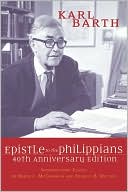
Karl Barth, Epistle to the Philippians

This interesting little commentary is one of the few examples of Barth's theological exegesis as it is applied to an entire book systematically. It doesn't rival other more traditional commentaries as far as exegetical insight, but it contains a number of gems, and reflects a deep and sustained engagement with the text. Barth illumines a number of theological themes in the letter in his own distinctive way, and, as is reflected by citations of this book in many modern commentaries, certainly makes a contribution to the understanding of Philippians. I most thoroughly enjoyed his discussion of Phil 3:8-9 and the subject of faith and righteousness. This brief discussion alone is worth the price of the book. While I won't be consulting this little commentary first or most frequently in future studies of Philippians, I certainly won't neglect it either, especially when looking at those more theologically dense passages.

William Webb, Slaves, Women & Homosexuals

I think it is fair to say that hermeneutics, and specifically hermeneutics as it relates to cultural anaylsis, is one of the most pressing issues facing the church today. How we understand Scripture to relate to its original culture and how we appropriate it in our own culture is one of the issues that is driving our current era of church history. How we understand issues such as those surrounding women and homosexuals are very live and important questions in our day. And this is why I commend William Webb's book as highly as I possibly can. He addresses these issues by carefully probing the underlying hermeneutical questions with thoroughness and and an irenic and humble spirit.

Webb begins by laying out the Christian's challenge with regard to these issues, "It is necessar for Christians to challenge their culture where it departs from kingdom values; it is equally necessary for them to identify with their culture on all other matters" (22, italics in original). This is difficult because though Scripture contains both culture-bound and transcultural elements, these would have been nearly indistinguishable to its original readers. The challenge, then, is to live out the spirit of the text without being too inseparably bound to the "isolated words." For Webb, this means undertaking a "redemptive-movement hermeneutic" as opposed to a "static" hermeneutic.

A redemptive-movement hermeneutic seeks to assess the "movement" of a text relative to its original cultural setting. It then moves into our own day and seeks to retain the same direction of movement relative to our current culture in places where our cultural setting has gone beyond that of the original culture. An explicit component of this assessment is that the Bible doesn't only contain an "ultimate" ethic, but often contains provisions, laws, and instructions that entail only a "partially realized" ethic. It is worth taking a second to look at the reasons Webb outlines for this to be so, because I don't think this concept is one most readers of Scripture consciously ascribe to. Webb asserts that God often inspired a "partially realized" ethic (1) for pastoral reasons, to stretch his people as far as they could go without snapping; (2) for padagogical reasons, to help people move from the known to a foreseeable future with enough continuity so they can find their way; (3) for evangelistic reasons, thus reform was intended to better social structures without being so radical as to jeopardize other aspects of the Christian mission; (4) to sustain competing values, such as upholding temporary values in pursuit of associated goods, such as slavery in service of social welfare or patriarchy in service to gender differentiation; and (5) for soteriological resons, to to deal with a fallen and sinful humanity to whom reform does not come easiliy and move us in a process of progressive sanctification.

Throughout the book, Webb sustains an argument that, taking the presence of elements of both an ultimate and a provisional ethic within Scripture (and he certainly acknowledges the presence of an ultimate ethic in Scripture), we must undertake careful cultural analysis to determine what components of Scripture are culture-bound and which are transcultural. Once this is done, we seek to uphold the transcultural components and seek to live out the culture-bound components through a process of "redemptive movement" where we seek to follow the redemptive spirit within the text by reapplying that same spirit to our own culture. Let's follow a similar flow to Webb's own argument to flesh this out a bit.

Webb argues that the neutral example of slavery provides an important case study for understanding how a redemptive movement hermeneutic works. The culture of the Ancient Near East and of the Greco-Roman world upheld a structure of slavery. The Bible, written within this culture, reflects this setting, in that it assumes the general structure of slavery. There are no explicit texts or passages that speak directly to the need for the abolition of slavery (except perhaps for Gal 3:28 and parallels); there are, on the flip side, though, many texts that assume that slavery exists. But many of these texts reflect a "redemptive movement," that is, they demonstrate a limited but real movement away from the worst abuses of slavery toward better and more equal treatment of slaves. This movement, when coupled with the ultimate ethic in Scripture that acknowledges the equality of all people before God and the need to love neighbor as self, points toward the need for further movement beyond the movement accomplished in the OT or NT. Thus, as we live out the spirit of these texts, we appreciate our different cultural setting and seek to move closer to the unrealized ultimate ethic of abolition of slavery, and even beyond this toward fuller workplace and economic justice.

Webb takes this same process of analysis into his discussion of texts surrounding women. In that cultural analysis, through the use of eighteen different criteria, he assesses the culture-bound components of patriarchy, relating to economic, social, and practical concerns. This analysis includes a careful exposition of the pertinent New Testament texts in their cultural settings, as well as a thorough discussion of the relation between the testaments on this point, and especially of the role played by Genesis texts in the discussion. He then couples this with an investigation of the ultimate ethic present in scripture, and concludes that the Bible moves toward a complementary egalitarianism or an ultra-soft patriarchy.

The third issue Webb looks at throughout the book is that of homosexuality. This is important in two respects. First, it is important because it is a vital issue in its own right, and second, because it is often related either positively or negatively to discussion of issues regarding women, usually to rhetorical effect. Thus, importantly, Webb demonstrates that the two issues, both needing careful cultural analysis, demonstrate opposite movements within Scripture. Whereas the patriarchy texts evidence a positive movement toward egalitarianism, the homosexual texts consistently demonstrate an absolute movement away from freedom to complete prohibition, and this movement is to be carried over into our own culture, albeit slightly modified.

William Webb's book is often cited and quoted in studies surrounding these important and divisive issues, and this is with good reason. I wish I had read this book years ago, and have deeply appreciated his hermeneutical insights. He shows how to recognize a redemptive movement in Scripture that acknowledges and appreciates the spirit of the text without being too bound to the "isolated words," by which he means the words taken in isolation from their cultural and canonical context. He demonstrates a genuine faithfulness to Scripture and an intense pursuit of God's truth and God's desire for our lives here in the in-between time, while also demonstrating how to carefully move beyond the bare words of Scripture in those cases when it is bound to its cultural setting. I look forward to appropriating his insights in future study. I must say that I also deeply appreciated his humble and irenic tone. He openly acknowledged the areas of greatest weakness in his own case (even writing a "What If I Am Wrong?" chapter to lay bare and discuss these weaknesses and their bearing on his case), and also sought to acknowledge the strengths of his opponents positions and demonstrated charitable readings of opposing views. All the same, I think he also admirably shows the promise of careful cultural analysis for faithful application of Scripture, in a convincing assessment of the issues surrounding both homosexuality and women. I also hope at the very least that this book dismantles the arguments often bandied about that those who favor women in ministry are on the slippery slope to accepting homosexuality or that those who accept women in ministry must make this subsequent move, as Webb demonstrates how this is clearly not so.

In all, this book is a landmark study of hermeneutics especially as it bears on these important issues, and is a must read for those on all sides of these pressing discussions. Do not miss this book, and do not delay.

December 10, 2008

Ben Witherington, The Lazarus Effect

I loved this book. Biblical Scholar Ben Witherington and his wife Ann Witherington have put together a great, plausible work of fiction, and I enjoyed reading it. And further than that, I learned something.

Art West, a well-known biblical archaeologist, makes an astonishing discovery. In an unexcavated mound in Bethany, he finds the tomb of Lazarus, Mary, and Martha. In it is reference to Lazarus's first "resurrection" from the dead and his eventual death, as he awaits the second resurrection. Also discovered is an ancient manuscript of the Gospel of John in Aramaic, shedding important light on the origin and nature of that Gospel (Witherington, a Johannine scholar, makes some interesting points about dating and authorship). But before West can make the discovery known, he is trapped inside the tomb, and before he can show the discovery to the world, the tomb is robbed and the inscription is stolen. Thus begins a chase to find this astonishing piece of history amid doubts about its authenticity and among an interesting inter-religious setting in Jerusalem. West is aided by his Jewish friend and scholar Grace Levine, and by his Muslim friends Kahlil El Asad and his daughter Hannah, antiquities dealers in the old city. As the story moves forward the pace picks up as Art is framed for having a fake inscription made and also for shooting his friend Kahlil. With so many rumors swirling in such a volatile world, suspicion rests on Art, and he finds himself on trial for the killing and for the forgery. And more stories intertwine, as fundamentalist Christians and ultra-Orthodox Jews both see West as someone who is compromising the essentials of the faith. The complexity of the plot really helps to illumine the complexity of the real-life situation in modern Israel.

The Witheringons' book is a real page turner, with a great plot and interesting characters. But what sets it apart is both the plausibility of its events (Ben Witherington is an expert in the James ossuary, a real-life artifact of similar significance also fraught with suspicion) and the quality of its history. It is obvious that the authors know the Biblical world and modern Israel well, and they help the reader to feel some of the important dynamics between the various groups. The relationship between evangelicals and more fundamentalist dispensationalist Christians and Zionists, and ultra-Orthodox Jews are also brought into the mix as well, along with Muslims. But in all things, the Witheringtons' bring respect to their portrayals, not caricatures. His discussion of the dating and provenance of John's Gospel (that Lazarus is the beloved disciple, the primary author of the Gospel) is an interesting argument, here made very well at a popular level. I've read some of his material elsewhere on this idea, and it is an interesting one to ponder, not least because it fits with the setting of most events in the Gospel and is given further creedance by some verbal connections with Lazarus as one whom Jesus "loved." Finally, the Witheringtons also bring a great glimmer of hope to the situation as the "Lazarus Effect"--new life from the dead--takes hold among many of the characters and brings hope in unexpected places. It certainly isn't serious scholarship, nor is it meant to be, but that doesn't mean it's flippant or shallow either. Instead, it provides a great story with just enough nuance to give it depth. I think this book is a great read and would make a great gift.

December 04, 2008

Scot McKnight, The Blue Parekeet

Scot McKnight, well known blogger and author, challenges readers to think about how they read the Bible in this great little book. The challenge McKnight lays down to readers is to think about what it means to be "biblical" in our thinking, speaking, and acting. Though we may think we mean simply "doing what the Bible says," he shows us that for almost all of us, that is clearly not the case. Through some simple examples he shows that we all pick and choose what we apply and how. The question explored throughout the rest of the book, then, is why and how do we do this. He asserts that "adopting and adapting," a more positive spin on the phenomenon, is indeed the right way to read the Bible, as we seek to discern both how God spoke in the past and how God is speaking to us in our day in our way.

McKnight proposes a three-stage process in our reading and applying the Bible: Story, Listening, Discerning. The first case he sets out to make is that the Bible is fundamentally a Story, or more properly, a variety of retellings of the one Story: Creating Eikons; Cracked Eikons; Covenant Community; Christ, the Perfect Eikon, redeems; Consummation. That, in a nutshell (and in Scot's own distinctive terminology) is the story of the Bible. The 66 books of the Bible then make up "wiki-stories," retellings in often distinctive ways, with varying emphases and language in different times and settings, of this one overarching story. And here is one of McKnight's core assertions, these "wiki-stories" are tellings of God's truth "in Moses' days in Moses' ways . . . in David's days in David's ways . . . in Jeremiah's days in Jeremiah's ways . . . in Jesus' days in Jesus' ways . . . in Paul's days in Paul's ways . . ." He concludes that we are "called to carry on that pattern in our world today" (28). The key to this movement into our own days and ways is Story, as we recognize the story and its retellings in the Bible and seek to enter into that same story in our day.

The second section of the book takes up the second stage in our reading and applying the Bible: Listening. McKnight emphasizes that we listen to the Bible because we have a relationship with the God of the Bible. That relationship forms the ground and purpose of our reading and listening. He seeks to get past abstract discussions of the Bible's authority, past having a "view" of the Bible, as legitimate as these things may be, to focus on having "a 'relationship' to the God of the Bible" (95). This understanding then shapes our listening, as we listen attentively to and for God, we are attentive in recognizing God speaking, we absorb what God says and we act on what we hear (99). This puts a helpful emphasis on the way the Bible must shape us as we listen. We aren't just mining the Bible for "truth" or theology but we are encountering God speaking to us, and must act and react accordingly.

The third stage we encounter is Discerning. After we have recognized the story in the text and have listened attentively to God speaking through his Word, we must discern our part in the story, we must discern what we are then to do. Here he argues that the "adopt and adapt" strategy that all Christians implicitly or explicitly espouse is in fact the right idea. We must recognize that "that was then and this is now." But this is not simply a personalistic anything goes reading of Scripture, but is a discerning, with (as opposed to through) tradition, in community. We need to recognize that the Bible itself points toward a strategy of discernment, and that the church has likewise passed on this legacy of a "pattern of discernment" (118). McKnight acknowledges the messiness of the process, and that it means there will be disagreements. But, he writes, "it is the attempt to foist one person's days and ways on everyone's days and ways that quenches the Holy Spirit" (143). It is because of the gospel that we strive to adapt, just as Paul says in 1 Corinthians 9. We, like Paul, should be governed by what furthers the gospel the most (142). Thus, "Living out the Bible means living out the Bible in our day in our way by discerning together how God would have us live" (143, italics in original).

These three stages sketch McKnight's proposal for how we should approach and appropriate the Bible in our own day. The fourth part of the book provides an extended case study in this method, using the question of women in ministry as an example of "adopting and adapting." In this fourth part, he lays out a careful argument, beginning with what women did in the Old and New Testament times and in the Early Church, and with what the Bible says about women and ministry. He looks at how we can recognize the cultural distance between these past times and our own, but also focuses on how we can recognize the "story" in the Bible that spoke powerfully in past days and again in our own. Through this process, he makes the argument that discerning God speaking in the story of the Bible and discerning how God would have us act today, with a focus on the message of the gospel, leads to the full participation of women in the life and ministry of the church.

I thoroughly enjoyed this very readable introduction to how we read and apply the Bible. I have no doubt that almost all Christians could benefit from a book like this, as all too often we assume that we're being "biblical" without recognizing the complexities involved in our own positions. This little primer on hermeneutics is a great way for people in the pews to begin to come to terms with these important issues. But, importantly, this isn't a cause for consternation but for hope. Instead of being paralyzed by fear of the messiness of discernment, we should be energized by the gospel and our part in the story as we acknowledge the God of the Bible speaking to us even down to our own day. This book is clearly at an introductory level, as McKnight acknowledges along the way, but I think it agreeably whets the appetite for further study into these important questions. And I think it is a helpful introduction into the Bible as "Story," as we recognize the great divine drama into which we are called. I also enjoyed his case study on women in ministry. His arguments and his own personal journey make for very compelling reading. I think he shows beyond doubt that the church, at the very least, has restricted women beyond even the restrictions they faced in New Testament times, and he points toward a fuller inclusion of women in all areas of the church. While he obviously doesn't engage with the vast array of scholarship or the serious technical issues involved in the debate, his case study provides a great "egalitarian" introduction into the debate.

In all, I think McKnight's Blue Parakeet is an important guide to seeing the Bible as it really is and to recognize how we do and how we should read and apply it.

The closest we get to heaven . . .

My son Lucas had just awakened from his nap. As I held him, he snuggled into my shoulder for a minute or two--waking up is so hard. And as I enjoyed his embrace, it occurred to me that that feeling, loving embrace, may be the closest we get to heaven in this life. I've just enjoyed a couple wonderful books on the Trinity (Coppedge, The God Who Is Triune, and Shults, Reforming the Doctrine of God), and one of the beautiful pictures they paint is of God's life as a mutual sharing and indwelling and relating. Instead of thinking of God as a static monad, we develop a picture of dynamic, vibrant life and love. Further, we come to reimagine our relationship to God. We come to see salvation as including the joining of our lives to the Trinitarian life, a participating with God in this beautiful relationship. Paul uses the image of marriage to point toward the beautiful intimacy and union the church shares with Christ, and likewise the Gospel of John repeatedly talks of Jesus' unity with the father and believers' unity with Christ. There is a beautiful embrace that takes place here. (Cf. Miroslav Volf, Exclusion and Embrace; I'll need to go back and give it some attention when the opportunity presents itself.) So, I say, the beautiful contented and loving embrace of a father with child and of a husband and a wife are the closest we get here on Earth to experiencing everlasting life. And that's a great thought.

November 24, 2008

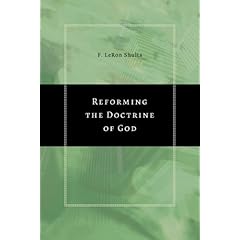
F. LeRon Shults, Reforming the Doctrine of God

In Reforming the Doctrine of God, LeRon Shults takes a sustained look at theology proper, but he does it with an important contemporary twist. Shults asserts that theology must be done as a "messy reciprocity between our ideas about God and everything else" (12). That is, theology is (inevitably) conditioned by our understanding of the world, just as it conditions that same understanding. It is with this basic insight in mind that he sets out to reform the doctrine of God.

Why reform? The reason, as laid out in the first part of the book, is because too much of theology has been inextricably linked with outmoded philosophical categories that see God as immaterial substance, single subject, and first cause. These categories, he asserts, lead to problems with our thinking about God that are created more by the categories than by the reality they seek to illuminate. In the second part of the book, Shults looks at a number of "late modern" trends that can prove as resources to reinvigorate our thinking about God by overcoming some of the philosophical barriers of modern thinking. Specifically, he looks at divine infinity, the trinity, and eschatological ontology as three important streams of thought that are reshaping how we think of God.

In this review, I'm not going to try to expound either of these parts in detail, for a couple of reasons. First, and probably most important, philosophical theology is not my own specialty, and I fear any summary I give would only distort his points, rather than illuminating them. Second, he draws on a broad range of streams of modern and late modern thought in his critiques and constructions, and a concise summary would not do them justice, especially if you aren't already familiar with his subjects. But, a few comments will hopefully give at least some insight in to where he is going.

Shults demonstrates, successfully, I think, that some of the classic dilemmas in theology, such as how God works in the world or how divine sovereignty and human freedom are compatible, are at least in part caused by assumptions and categories that are foreign to the Bible. His second point, worked out in part two, is that many late modern thinkers have begun to rethink some of these basic assumptions and have collectively reclaimed some important ways of thinking about God that have been too often lost or diminished in modern theological thinking. And in each chapter he surveys a number of important thinkers from a variety of perspectives, such as Karl Barth, Jürgen Moltmann, Wolfhart Pannenberg, and John Zizioulas, to show the sources and contours of these important developments. The three streams that are recovered focus on God's infinity (God is more than just "extensively" greater than creatures but is genuinely "other"), trinity (God is not a single substance or mind but is dynamic relationality in himself), and futurity (God relates to time not only as its originator but as its upholder and as its future hope and consummation). All of this is helped by what he calls a "turn to relationality" in philosophy, with a movement away from a more substance-based view of reality to the acknowledgment as relationship or relationality as basic to the constitution of what it means to be person.

It is in part three that the the real "reforming" takes place, as Shults seeks to rebuild the doctrine of God through a critical appropriation of many of the late modern trajectories into a constructive exposition of theology. He looks at God's knowing, acting, and being through the themes of omniscient faithfulness, omnipotent love, and omnipresent hope. As with the first two parts, I won't try to recreate the flow of his argument. Instead, I want to note that he takes head on three of the thorny (and fascinating) issues that confront theology, the "antinomies" of divine foreknowledge, divine predestination, and divine timelessness. In each case, he surveys the state of the discussion and proposes a way forward that liberates the discussion from the classic categories that create the problems in the first place. In each case, I found his proposals to be insightful and liberating while remaining true to the core biblical insights that provide the foundation for the discussions. Just these three discussions are easily worth the price of the book, but I think the book's greatest value is that the "solutions" to these three problems point toward a richer and more dynamic doctrine of God.

I read the whole third part of this book with growing appreciation and excitement, and I look forward to delving in to Shults's other books and seeing how his vision plays out across the various ares of theology. But I know that the groundwork laid here is deeply valuable. It certainly struck a chord with me both in its freshness and its faithfulness. I look forward to rereading these final chapters again as I reflect on who God is and how we think of him. This book is highly recommended, though it certainly contains a lot of technical language. It is at times a rather difficult read, but it will repay a careful reading. For anyone who is interested in contemporary evangelical theology, this book is essential reading, and is a profound example of a vibrant and delightful investigation and appreciation of who God is.

November 16, 2008

Allan Coppedge, The God Who Is Triune

In The God Who Is Triune, subtitled Revisioning the Christian Doctrine of God, Coppedge undertakes a systematic exposition of the doctrine of God. The key to the book, though, as its title makes clear, is that Coppedge draws on the triunity of God as the key for his reconstruction. The book opens with two chapters laying out the New Testament evidence, larger biblical "frame," and early theological developments toward understanding God as triune, making a case that understanding God as three in one and one in three, as Father, Son, and Holy Spirit, is essential to understanding who God is. He then goes on to construct a fuller doctrine of God, covering the classic themes of God's attributes, creation, and providence, but he does it all after laying the trinitarian groundwork and in light of these fundamental insights. This makes Coppedge's book a valuable contribution to the field.

Coppedge's material on the Trinity is very well done, and I think he lays out very clearly and helpfully the essentials necessary for constrcting a theology of the Trinity. He shows much sympathy toward an Eastern approach to the Trinity that starts more from God's threeness and goes on to assert God's unity, though he also shows sympathies toward the more Western, Augistinian approach of starting from God's unity. Overall, though, this Eastern trend helps give the trinitarian drama to his whole presentation, as it keeps the vibrant interrelational life of God center stage as moves on to discuss God's being and attributes and God's relation to creation.

One of the defining insights of the book is that a Trinitiarian starting point means that when one moves to discussing God, the traditional four categories of attributes are still discussed--personal, moral, relative, and absolute--but they are approached in a different order. Coppedge begins with God's personal attributes (discussing attributes such as God's social nature, life, heart, moral capacity, freedom, creativity, and responsibility) and moral attributes. Only then does he move on to God's relative and absolute attributes. This means that God's sociality, will, freedom, and righteousness come before and exercise a controling role over attributes such as omnipotence. The result of this is that a picture of a vibrant, alive, relating God comes to the fore. This doesn't lessen God's glory or holiness, or diminish God's transcendence, but it means that who God is isn't lost in discussions of what God is capable of. Instead of focusing on God's being in himself, with a focus on God's unity as the omnipotent and omnipresent being above and beyond the universe one meets God as Father, Son, and Spirit, forever relating as living, loving, active beings who come to meet us in holiness and invite us to enter into their trine life. That, to me, is the refreshing aspect of this book. The Doctrine of God doesn't become abstract philosophical discussions about categories of being, though it does contain that, but it focuses instead on God as he makes himself known in a personal way. The focus is thereby supremely on God as made known in Jesus Christ, who becomes the key for our understanding of who God is.

I found Coppedge's expositon of the entire doctrine of God based on a trinitarian starting point to be supremely helpful. It helps to illumine all of theology by adding a relational element to God's very existence. It also points Coppedge (a Weslyan) toward an understanding of providence and freedom that entails God inviting human persons to enter into genuine relations with God and each other in true freedom. In short, I think it is one of the most helpful defenses I have read of a Weslyan (that is, essentially an Arminian) understanding of providence and free will, drawing as it does on God's very nature as the ground for its theological reasoning.

I highly recommend this book as a great resource on the doctrine of the Trinity, but more than that, I think it is essential reading for an example of how Trinity matters to all of Christian life and thought, instead of being a mere appendix to the doctrine of God to set it apart from other non-Christian expositions of theism. Not only did I benefit from it, but I enjoyed reading it. And further more, I was drawn closer to God through it, by being reminded that God isn't an amorphous being up there but is instead chooses to be known as Father, Son, and Spirit: in short, God lets us know who he is, and that's a lot more intimate than focusing on what or that God is.