January 20, 2009

I. Howard Marshall, Aspects of the Atonement

Based in part on his 2004 F. F. Bruce lecture at Highland Theological College, this great little book is an important and even-handed look at the atonement. Its four chapters entail three major foci. The first two chapters deal specifically with the doctrine of penal substitution through a careful look at its two constituent parts, with a careful study of the penalty for sin in chapter 1 and a sustained look at substitution as it relates to the atonement in chapter 2. Throughout these chapters, Marshall carefully takes into account recent critiques of the doctrine as well and weighs them against a careful investigation of the biblical basis. Through this study, he demonstrates the importance of the doctrine of penal substitution but also how it could be better formulated to avoid excesses and misrepresentations. Thus, he carefully critiques and also defends this important doctrine. He looks specifically at issues of violence, wrath, and suffering, as these often come up in critiques of the doctrine. (A proper trinitarian understanding of God and God's action plays a central role here.) In all, he forcefully demonstrates that the fundamental ideas behind the doctrine of penal substitution are important and essential facets of a doctrine of atonement.

In the third chapter, Marshall sets out to investigate how the resurrection of Jesus relates to atonement. While much thought rightly focuses on Jesus' death as the location of atonement, too often this is done without giving necessary attention to how the resurrection likewise plays an important role. Through a sustained look at Romans 4:25 (Jesus was delivered over to death for our sins and raised to life for our justification), Marshall shows how the resurrection can and should play a helpful and central role in our thinking about atonement, especially as it is connected with the them of new life, and how it should be seen as an essential part of God's work of justification.

In the fourth chapter, Marhshall puts forth reconciliation as a helpful overall scheme for thinking of the atonement. While reconciliation and its attendant word forms are not prevalent in the New Testament, Marshall shows how related themes of forgiveness and peace, which play an important part in the NT, point toward reconciliation as an important and helpful way of thinking about what the atonement accomplishes.

I greatly enjoyed this very readable little book. Marshall is very sensitive to modern critiques of the doctrine of penal substitution, and both shows the value in the critiques and also the enduring value of this historic doctrine. For any who are interested in this ongoing debate, I highly recommend this book. It is also very valuable for its second half, with a great discussion of resurrection and of reconciliation. In all, this is a great exposition of the doctrine of the atonement.

January 13, 2009

More on the Millennium: Why?

I must admit that one of my principal objections to the idea of a millennial kingdom has always been that it seems so pointless. It is a doctrine that is only taught specifically in one place (Rev 20), and even there the precise reading is contested. It is consistent with some other themes and teaching in the Old and New Testament, but it certainly isn't required by other discussion of the end times elsewhere in Scripture. So this has always raised the question for me of why there should be a millennium. Why not go with a simple (essentially amillennial) approach that understands Jesus return to be immanent, with his return inaugurating the final judgment, the resurrection to the life to come, and the new creation. And I must admit, even in my recent study on the topic of the millennium, and my own movement toward a "premillennial" position, this has been a nagging objection.

But in my continued reading, I've read what G. E. Ladd has to say about the Apocalypse in A Theology of the New Testament (the discussion is at pp 630-31 in the first edition, and quotations come from there). And there, he discusses very helpfully how we might begin to understand a millennial reign of Christ--he puts some logic to it.

(Now I admit that we don't certainly only believe things that we fully understand, and just because I don't see the reason for something doesn't mean that God can't or shouldn't do something that way; and some things we read in Scripture are that way--God reveals to us his ways and plans. So don't read too much into my objections. But in this case, it is of a bit more validity because the question arises of how we should read Rev 20 in relation to the rest of the NT and of the Bible, seeking to shape the reading of one based on the other, so a fuller canonical understanding of eschatology certainly comes into play at some level.)

Anyway, on to the logic of the millennium. Ladd writes, "There should be no objection to the idea of such a temporal kingdom in principle . . ." And he goes on to explain. First, the idea of a temporal reign (that is, Christ reigning within history and not only beyond it) fits with the fact that Christ is currently reigning now in the church age. There is now a sense in which that reign is not fully revealed or realized, but it is still a reality. And this is one of the theological reasons Ladd points to for thinking about a millennial reign: it is the consummation of Christ's reign on earth, the realization of that which is now only partly manifest. And this reign is millennial (and thus only temporary in some sense) because Christ then turns over his glory and sovereignty to the Father in the age to come. (I admit that there is a certain logic to this, in light of various biblical discussions about the end, but I need to do some more reflection on the trinitarian implications of this, including the idea that Christ is in eternal and final subjection to the Father instead of an eternal coregnant.)

The second logical and theological reason Ladd explores for the millennium has to do with God's justice. The millennial reign of Christ will be a time when Satan is bound and the social environment will be "as nearly perfect as possible." But at the end of this time, Satan will be loosed and will again deceive the nations. Thus, the logic for God's justice goes something like this. Some may say that humans are at least in part not to blame for their sin and their harness of heart due to the environmental and societal factors that come into play. But this objection will be truly and finally demonstrated as false as the millennium demonstrates the true wickedness and hardness of the huaman heart. Ladd writes that "in the final judgment of the great white throne every mouth will indeed be stopped and every excuse voided, to the vindication of the glory and the righetousness of God." In a sense, the millennium is the final proof of God's justice, and provides the backdrop for God's final judgment of all people for all time.

While the logic may not "require" a millennium, it helps make some sense of what God is about. It is certainly food for thought.

January 11, 2009

Revelation and the Millennium

The EFCA has recently revised its Statement of Faith (see my earlier comments here). One of the major modifications was the inclusion of "premillennialism" in the statement. I must admit that I initially met this inclusion with some skepticism--do we really need to enshrine that particular belief in our statement, especially considering the number of Christians holding varying opinions.

Our church (Oxboro Ev. Free Church) is going to be looking at the changes to the statement in the coming weeks, so I thought I'd begin doing some homework. And though I've studied and read about Revelation and issues surrounding the Millennium before, I've never really delved deeply into it, and never really come to any opinion on it myself, even a provisional one. And I figured this would be a good time to get working. So I pulled a number of books off my shelves and got to reading. At first, I was struck by the breadth of the views I was finding. It seemed that each position had some positives and some negatives.

So I sat down and read Revelation from start to finish, essentially non-stop. (I must say I highly recommend this, especially after perusing an introduction or two to get your bearings.) And was struck by how powerful the words would have been to its first audience, Asian Christians facing persecution. It seems we all too often forget that they are the adressees of the letter! I must admit that this doesn't easily and quickly solve any of the thorny and complicated exegetical issues of the book, but it does immediately and powerfully open up the main thrust of the book: God is holy, mighty, powerful, the Savior! He was and is and is to come. And despite how things may look at the moment, he's got the whole world in his hands, and his judgments are just. We can expect some tough times, difficult persecutions, maybe even death for his name. But don't be fooled--God is on the throne, and he is coming again to vindicate the righteous and to set the world right.

So there's a thumbnail sketch of Revelation. It is easy to see why this book has inspired so many songs, poems, and prayers. (Think Milton, for one easy example.) But what about the Millennium? Like I said, I didn't come up with any easy answers to the thorny questions. But. After a lot of reading (from commentators like Robert Mounce in the NICNT to Craig Koester to Ben Witherington, from the NT theology of I. H. Marshall, and from theologians like Donald Bloesch and Wayne Grudem), I am more and more convinced that while I may have some type of affinity with an amillennial position (more for aesthetic reasons than anything else, I think), I keep being lead toward premillennialism. Though it is also abundantly clear that this is not an obvious road to take (a commentator as responsible and mature as I. H. Marshall essentially dismisses premillennialism out of hand in his NT Theology). And right now, the most clear and convincing piece of the argument goes back to where I started in my exploration, thinking about the original audience. Amillennialism and Postmillennialism may seem like equally viable options now, two millennia later, as we look over the past and possible future. There's a church age, that may be somehow related to the millennium (amillennialists would say it has been and is the "millennium" and postmillennialists would say something like it is becoming or will become the millennium). But, what of the original authors, who didn't have that church age behind them. In fact, one of the clearest and probably most secure pieces of NT data we have is that the NT authors didn't expect a long and extended "church age." They expected Christ's return at any moment. In Revelation, for instance, just turn the page from Revelation 20 and the discussion of the millennium and you get to Revelation 22: Come Lord Jesus! And the same expectation permeates Paul, the Gospels, and the other NT writings as well. Jesus is coming again; soon! While this may not be a totally secure argument for premillennialism, (and while it argues more persuasively against postmillenniallism than amillennialism) it sure makes good sense of the data in a very natural way.

December 20, 2008

Propositions in theology

One of the major developments in "late-modern" and "post-conservative evangelical" theology is a movement away from propositions as the central and sufficient way of enshrining the gospel message. I have watched and learned of this trend with mixed emotions. I warm to it in the sense that over-focus on propositions seems to tame the gospel into information or language games. On the other hand, I am cautious about overstating the folly of propositions, because, regardless of the exact status we ascribe to propositions in our theology, there is an irreducible propositional content to our talk about God, it seems to me, even if it is variably expressed. LeRon Shults, in a post from a couple years ago, talks about propositions with regard to the emergent movement. It gives some interesting food for thought. And while I agree with him that often "statements of faith" serve as means to exclude, and am continuously drawn to an approach that seeks to focus on the center rather than fixing the boundaries, I also worry that eschewing statements of faith, even as provisional tools, is equally a cause for concern.

December 13, 2008

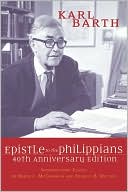
Karl Barth, Epistle to the Philippians

This interesting little commentary is one of the few examples of Barth's theological exegesis as it is applied to an entire book systematically. It doesn't rival other more traditional commentaries as far as exegetical insight, but it contains a number of gems, and reflects a deep and sustained engagement with the text. Barth illumines a number of theological themes in the letter in his own distinctive way, and, as is reflected by citations of this book in many modern commentaries, certainly makes a contribution to the understanding of Philippians. I most thoroughly enjoyed his discussion of Phil 3:8-9 and the subject of faith and righteousness. This brief discussion alone is worth the price of the book. While I won't be consulting this little commentary first or most frequently in future studies of Philippians, I certainly won't neglect it either, especially when looking at those more theologically dense passages.

William Webb, Slaves, Women & Homosexuals

I think it is fair to say that hermeneutics, and specifically hermeneutics as it relates to cultural anaylsis, is one of the most pressing issues facing the church today. How we understand Scripture to relate to its original culture and how we appropriate it in our own culture is one of the issues that is driving our current era of church history. How we understand issues such as those surrounding women and homosexuals are very live and important questions in our day. And this is why I commend William Webb's book as highly as I possibly can. He addresses these issues by carefully probing the underlying hermeneutical questions with thoroughness and and an irenic and humble spirit.

Webb begins by laying out the Christian's challenge with regard to these issues, "It is necessar for Christians to challenge their culture where it departs from kingdom values; it is equally necessary for them to identify with their culture on all other matters" (22, italics in original). This is difficult because though Scripture contains both culture-bound and transcultural elements, these would have been nearly indistinguishable to its original readers. The challenge, then, is to live out the spirit of the text without being too inseparably bound to the "isolated words." For Webb, this means undertaking a "redemptive-movement hermeneutic" as opposed to a "static" hermeneutic.

A redemptive-movement hermeneutic seeks to assess the "movement" of a text relative to its original cultural setting. It then moves into our own day and seeks to retain the same direction of movement relative to our current culture in places where our cultural setting has gone beyond that of the original culture. An explicit component of this assessment is that the Bible doesn't only contain an "ultimate" ethic, but often contains provisions, laws, and instructions that entail only a "partially realized" ethic. It is worth taking a second to look at the reasons Webb outlines for this to be so, because I don't think this concept is one most readers of Scripture consciously ascribe to. Webb asserts that God often inspired a "partially realized" ethic (1) for pastoral reasons, to stretch his people as far as they could go without snapping; (2) for padagogical reasons, to help people move from the known to a foreseeable future with enough continuity so they can find their way; (3) for evangelistic reasons, thus reform was intended to better social structures without being so radical as to jeopardize other aspects of the Christian mission; (4) to sustain competing values, such as upholding temporary values in pursuit of associated goods, such as slavery in service of social welfare or patriarchy in service to gender differentiation; and (5) for soteriological resons, to to deal with a fallen and sinful humanity to whom reform does not come easiliy and move us in a process of progressive sanctification.

Throughout the book, Webb sustains an argument that, taking the presence of elements of both an ultimate and a provisional ethic within Scripture (and he certainly acknowledges the presence of an ultimate ethic in Scripture), we must undertake careful cultural analysis to determine what components of Scripture are culture-bound and which are transcultural. Once this is done, we seek to uphold the transcultural components and seek to live out the culture-bound components through a process of "redemptive movement" where we seek to follow the redemptive spirit within the text by reapplying that same spirit to our own culture. Let's follow a similar flow to Webb's own argument to flesh this out a bit.

Webb argues that the neutral example of slavery provides an important case study for understanding how a redemptive movement hermeneutic works. The culture of the Ancient Near East and of the Greco-Roman world upheld a structure of slavery. The Bible, written within this culture, reflects this setting, in that it assumes the general structure of slavery. There are no explicit texts or passages that speak directly to the need for the abolition of slavery (except perhaps for Gal 3:28 and parallels); there are, on the flip side, though, many texts that assume that slavery exists. But many of these texts reflect a "redemptive movement," that is, they demonstrate a limited but real movement away from the worst abuses of slavery toward better and more equal treatment of slaves. This movement, when coupled with the ultimate ethic in Scripture that acknowledges the equality of all people before God and the need to love neighbor as self, points toward the need for further movement beyond the movement accomplished in the OT or NT. Thus, as we live out the spirit of these texts, we appreciate our different cultural setting and seek to move closer to the unrealized ultimate ethic of abolition of slavery, and even beyond this toward fuller workplace and economic justice.

Webb takes this same process of analysis into his discussion of texts surrounding women. In that cultural analysis, through the use of eighteen different criteria, he assesses the culture-bound components of patriarchy, relating to economic, social, and practical concerns. This analysis includes a careful exposition of the pertinent New Testament texts in their cultural settings, as well as a thorough discussion of the relation between the testaments on this point, and especially of the role played by Genesis texts in the discussion. He then couples this with an investigation of the ultimate ethic present in scripture, and concludes that the Bible moves toward a complementary egalitarianism or an ultra-soft patriarchy.

The third issue Webb looks at throughout the book is that of homosexuality. This is important in two respects. First, it is important because it is a vital issue in its own right, and second, because it is often related either positively or negatively to discussion of issues regarding women, usually to rhetorical effect. Thus, importantly, Webb demonstrates that the two issues, both needing careful cultural analysis, demonstrate opposite movements within Scripture. Whereas the patriarchy texts evidence a positive movement toward egalitarianism, the homosexual texts consistently demonstrate an absolute movement away from freedom to complete prohibition, and this movement is to be carried over into our own culture, albeit slightly modified.

William Webb's book is often cited and quoted in studies surrounding these important and divisive issues, and this is with good reason. I wish I had read this book years ago, and have deeply appreciated his hermeneutical insights. He shows how to recognize a redemptive movement in Scripture that acknowledges and appreciates the spirit of the text without being too bound to the "isolated words," by which he means the words taken in isolation from their cultural and canonical context. He demonstrates a genuine faithfulness to Scripture and an intense pursuit of God's truth and God's desire for our lives here in the in-between time, while also demonstrating how to carefully move beyond the bare words of Scripture in those cases when it is bound to its cultural setting. I look forward to appropriating his insights in future study. I must say that I also deeply appreciated his humble and irenic tone. He openly acknowledged the areas of greatest weakness in his own case (even writing a "What If I Am Wrong?" chapter to lay bare and discuss these weaknesses and their bearing on his case), and also sought to acknowledge the strengths of his opponents positions and demonstrated charitable readings of opposing views. All the same, I think he also admirably shows the promise of careful cultural analysis for faithful application of Scripture, in a convincing assessment of the issues surrounding both homosexuality and women. I also hope at the very least that this book dismantles the arguments often bandied about that those who favor women in ministry are on the slippery slope to accepting homosexuality or that those who accept women in ministry must make this subsequent move, as Webb demonstrates how this is clearly not so.

In all, this book is a landmark study of hermeneutics especially as it bears on these important issues, and is a must read for those on all sides of these pressing discussions. Do not miss this book, and do not delay.

December 10, 2008

Ben Witherington, The Lazarus Effect

I loved this book. Biblical Scholar Ben Witherington and his wife Ann Witherington have put together a great, plausible work of fiction, and I enjoyed reading it. And further than that, I learned something.

Art West, a well-known biblical archaeologist, makes an astonishing discovery. In an unexcavated mound in Bethany, he finds the tomb of Lazarus, Mary, and Martha. In it is reference to Lazarus's first "resurrection" from the dead and his eventual death, as he awaits the second resurrection. Also discovered is an ancient manuscript of the Gospel of John in Aramaic, shedding important light on the origin and nature of that Gospel (Witherington, a Johannine scholar, makes some interesting points about dating and authorship). But before West can make the discovery known, he is trapped inside the tomb, and before he can show the discovery to the world, the tomb is robbed and the inscription is stolen. Thus begins a chase to find this astonishing piece of history amid doubts about its authenticity and among an interesting inter-religious setting in Jerusalem. West is aided by his Jewish friend and scholar Grace Levine, and by his Muslim friends Kahlil El Asad and his daughter Hannah, antiquities dealers in the old city. As the story moves forward the pace picks up as Art is framed for having a fake inscription made and also for shooting his friend Kahlil. With so many rumors swirling in such a volatile world, suspicion rests on Art, and he finds himself on trial for the killing and for the forgery. And more stories intertwine, as fundamentalist Christians and ultra-Orthodox Jews both see West as someone who is compromising the essentials of the faith. The complexity of the plot really helps to illumine the complexity of the real-life situation in modern Israel.

The Witheringons' book is a real page turner, with a great plot and interesting characters. But what sets it apart is both the plausibility of its events (Ben Witherington is an expert in the James ossuary, a real-life artifact of similar significance also fraught with suspicion) and the quality of its history. It is obvious that the authors know the Biblical world and modern Israel well, and they help the reader to feel some of the important dynamics between the various groups. The relationship between evangelicals and more fundamentalist dispensationalist Christians and Zionists, and ultra-Orthodox Jews are also brought into the mix as well, along with Muslims. But in all things, the Witheringtons' bring respect to their portrayals, not caricatures. His discussion of the dating and provenance of John's Gospel (that Lazarus is the beloved disciple, the primary author of the Gospel) is an interesting argument, here made very well at a popular level. I've read some of his material elsewhere on this idea, and it is an interesting one to ponder, not least because it fits with the setting of most events in the Gospel and is given further creedance by some verbal connections with Lazarus as one whom Jesus "loved." Finally, the Witheringtons also bring a great glimmer of hope to the situation as the "Lazarus Effect"--new life from the dead--takes hold among many of the characters and brings hope in unexpected places. It certainly isn't serious scholarship, nor is it meant to be, but that doesn't mean it's flippant or shallow either. Instead, it provides a great story with just enough nuance to give it depth. I think this book is a great read and would make a great gift.

December 04, 2008

Scot McKnight, The Blue Parekeet

Scot McKnight, well known blogger and author, challenges readers to think about how they read the Bible in this great little book. The challenge McKnight lays down to readers is to think about what it means to be "biblical" in our thinking, speaking, and acting. Though we may think we mean simply "doing what the Bible says," he shows us that for almost all of us, that is clearly not the case. Through some simple examples he shows that we all pick and choose what we apply and how. The question explored throughout the rest of the book, then, is why and how do we do this. He asserts that "adopting and adapting," a more positive spin on the phenomenon, is indeed the right way to read the Bible, as we seek to discern both how God spoke in the past and how God is speaking to us in our day in our way.

McKnight proposes a three-stage process in our reading and applying the Bible: Story, Listening, Discerning. The first case he sets out to make is that the Bible is fundamentally a Story, or more properly, a variety of retellings of the one Story: Creating Eikons; Cracked Eikons; Covenant Community; Christ, the Perfect Eikon, redeems; Consummation. That, in a nutshell (and in Scot's own distinctive terminology) is the story of the Bible. The 66 books of the Bible then make up "wiki-stories," retellings in often distinctive ways, with varying emphases and language in different times and settings, of this one overarching story. And here is one of McKnight's core assertions, these "wiki-stories" are tellings of God's truth "in Moses' days in Moses' ways . . . in David's days in David's ways . . . in Jeremiah's days in Jeremiah's ways . . . in Jesus' days in Jesus' ways . . . in Paul's days in Paul's ways . . ." He concludes that we are "called to carry on that pattern in our world today" (28). The key to this movement into our own days and ways is Story, as we recognize the story and its retellings in the Bible and seek to enter into that same story in our day.

The second section of the book takes up the second stage in our reading and applying the Bible: Listening. McKnight emphasizes that we listen to the Bible because we have a relationship with the God of the Bible. That relationship forms the ground and purpose of our reading and listening. He seeks to get past abstract discussions of the Bible's authority, past having a "view" of the Bible, as legitimate as these things may be, to focus on having "a 'relationship' to the God of the Bible" (95). This understanding then shapes our listening, as we listen attentively to and for God, we are attentive in recognizing God speaking, we absorb what God says and we act on what we hear (99). This puts a helpful emphasis on the way the Bible must shape us as we listen. We aren't just mining the Bible for "truth" or theology but we are encountering God speaking to us, and must act and react accordingly.

The third stage we encounter is Discerning. After we have recognized the story in the text and have listened attentively to God speaking through his Word, we must discern our part in the story, we must discern what we are then to do. Here he argues that the "adopt and adapt" strategy that all Christians implicitly or explicitly espouse is in fact the right idea. We must recognize that "that was then and this is now." But this is not simply a personalistic anything goes reading of Scripture, but is a discerning, with (as opposed to through) tradition, in community. We need to recognize that the Bible itself points toward a strategy of discernment, and that the church has likewise passed on this legacy of a "pattern of discernment" (118). McKnight acknowledges the messiness of the process, and that it means there will be disagreements. But, he writes, "it is the attempt to foist one person's days and ways on everyone's days and ways that quenches the Holy Spirit" (143). It is because of the gospel that we strive to adapt, just as Paul says in 1 Corinthians 9. We, like Paul, should be governed by what furthers the gospel the most (142). Thus, "Living out the Bible means living out the Bible in our day in our way by discerning together how God would have us live" (143, italics in original).

These three stages sketch McKnight's proposal for how we should approach and appropriate the Bible in our own day. The fourth part of the book provides an extended case study in this method, using the question of women in ministry as an example of "adopting and adapting." In this fourth part, he lays out a careful argument, beginning with what women did in the Old and New Testament times and in the Early Church, and with what the Bible says about women and ministry. He looks at how we can recognize the cultural distance between these past times and our own, but also focuses on how we can recognize the "story" in the Bible that spoke powerfully in past days and again in our own. Through this process, he makes the argument that discerning God speaking in the story of the Bible and discerning how God would have us act today, with a focus on the message of the gospel, leads to the full participation of women in the life and ministry of the church.

I thoroughly enjoyed this very readable introduction to how we read and apply the Bible. I have no doubt that almost all Christians could benefit from a book like this, as all too often we assume that we're being "biblical" without recognizing the complexities involved in our own positions. This little primer on hermeneutics is a great way for people in the pews to begin to come to terms with these important issues. But, importantly, this isn't a cause for consternation but for hope. Instead of being paralyzed by fear of the messiness of discernment, we should be energized by the gospel and our part in the story as we acknowledge the God of the Bible speaking to us even down to our own day. This book is clearly at an introductory level, as McKnight acknowledges along the way, but I think it agreeably whets the appetite for further study into these important questions. And I think it is a helpful introduction into the Bible as "Story," as we recognize the great divine drama into which we are called. I also enjoyed his case study on women in ministry. His arguments and his own personal journey make for very compelling reading. I think he shows beyond doubt that the church, at the very least, has restricted women beyond even the restrictions they faced in New Testament times, and he points toward a fuller inclusion of women in all areas of the church. While he obviously doesn't engage with the vast array of scholarship or the serious technical issues involved in the debate, his case study provides a great "egalitarian" introduction into the debate.

In all, I think McKnight's Blue Parakeet is an important guide to seeing the Bible as it really is and to recognize how we do and how we should read and apply it.